Portkey's AI gateway sits between applications and supported language model providers, routing configured LLM traffic through a single endpoint while adding production controls like automatic retries, fallbacks, caching, and observability. Following its May 2026 acquisition by Palo Alto Networks, Portkey now operates as Prisma AIRS AI Gateway for enterprise customers. For organizations evaluating AI gateway options, understanding Portkey's pricing model, its log-based billing structure, and how it compares to enterprise-focused alternatives like Mintive's MCP Gateway is critical for making informed infrastructure decisions.
Key Takeaways
- Usage-based overages affect production costs: Portkey's Production tier costs $49/month with 100K recorded logs. Additional usage is priced at $9 per 100K requests, up to 3 million requests, making traffic volume an important factor in budgeting.
- Enterprise compliance requires custom pricing: Portkey lists SSO, HIPAA BAA availability, and custom retention periods under its Enterprise tier. Pricing is quote-based, although an AWS Marketplace Enterprise contract is listed at $99,999 for 12 months.
- Acquisition impacts roadmap certainty: Palo Alto Networks' May 2026 acquisition creates considerations for organizations evaluating long-term infrastructure stability and feature availability.
- Free tier has operational limitations: Developer tier offers only 3-day log retention and 10K logs/month, which may not satisfy production debugging or compliance requirements.
- Enterprise AI governance requires comprehensive oversight: Organizations deploying AI agents at scale need governed tool access, per-agent identities, and comprehensive audit trails that extend beyond model API management.
- Implementation enables rapid testing: Basic SaaS setup requires only a base URL change, enabling teams to evaluate the platform before committing to paid tiers.
Understanding the Enterprise AI Gateway Market and Portkey's Position
The enterprise AI gateway market has matured rapidly as organizations move from experimental AI deployments to production systems requiring governance, security, and cost controls. Portkey positions itself as a universal translator and traffic controller for AI model requests, routing calls through a single endpoint that handles authentication, retry logic, caching, and observability.
The Evolving Landscape of AI Gateways
Traditional API management platforms handle a range of traffic patterns, but AI workloads introduce additional challenges:
- Unpredictable token consumption
- Runtime tool selection
- Prompt injection risks
- The need to attribute actions to specific agents or users
This gap has created demand for purpose-built AI infrastructure.
Portkey addresses LLM routing and extends into MCP and agent governance. Its AI Gateway provides access to more than 1,600 models through a unified API, while its MCP Gateway adds authentication, tool-level access control, centralized credentials, and audit logging. Its Agent Gateway extends governance to registered agents with scoped permissions and observability.
However, enterprises deploying AI coding assistants and autonomous agents face broader governance challenges. Tools like Claude Code, Cursor, and ChatGPT don't just call LLM APIs; they access enterprise databases, file systems, and internal tools through protocols like MCP. Managing these connections requires governed tool access with SSO, SCIM-driven permissions, and audit trails that track what each agent reads and writes, not just which models it queries.
Portkey's AI Gateway: Beyond Basic API Management
Portkey's core value proposition centers on simplifying multi-provider LLM access while adding production-grade reliability and observability features.
Core Product Capabilities
The platform offers several interconnected features:
- AI Gateway: Single endpoint proxying to OpenAI, Anthropic, Google, Azure, AWS Bedrock, and other providers with automatic authentication handling
- Reliability features: Automatic fallbacks, retries, load balancing, and configurable timeouts to prevent downtime during provider outages
- Observability: Request logs, traces, cost tracking by model and user, latency metrics, and error rate dashboards
- Guardrails: Pre-built checks for content filtering, PII detection, and prompt injection prevention
- Prompt management: Version control for prompts, enabling teams to deploy new prompt versions without code changes
- Virtual keys: Wrapped provider credentials with per-key budgets and rate limits
For teams focused primarily on LLM API management, these capabilities address real operational pain points. Caching and routing controls can reduce redundant model calls and help manage API spending, although actual savings depend on application traffic patterns and configuration.
Unique Differentiators in Gateway Technology
Portkey's OpenAI-compatible API design minimizes migration friction. Developers can switch from direct OpenAI calls by changing only the base URL and API key, with no application code rewrites required. This approach enables rapid adoption and easy rollback if needed.
The platform also supports semantic caching, which stores and retrieves responses based on prompt similarity rather than exact matches. This can significantly reduce API costs for applications with repetitive query patterns. Semantic caching is available on paid hosted plans and was also added to Portkey's open-source production gateway in March 2026.
Unpacking Portkey's Pricing Model: What Drives the Cost?
Portkey's hosted pricing combines recorded-log allowances with request-based overage charges, while model-provider token costs remain separate. This structure creates several cost considerations for organizations.
Pricing Tier Breakdown
Open Source (Self-Hosted)
- Monthly Cost: Free, self-hosted
- Log Limit: No published vendor request cap
- Retention: Self-managed
- Key Features: Routing, retries, fallbacks, caching, open-source gateway controls
- Limitations: Infrastructure and operational costs
Developer
- Monthly Cost: Free
- Log Limit: 10K logs
- Retention: 3 days
- Key Features: Basic caching, deterministic guardrails
- Limitations: Not production-ready
Production
- Monthly Cost: $49
- Log Limit: 100K logs
- Retention: 30 days
- Key Features: Semantic caching, LLM guardrails, RBAC, alerts
- Limitations: Overage: $9/100K requests
Enterprise
- Monthly Cost: Custom
- Log Limit: 10M+ recorded logs monthly, custom limits
- Retention: Custom
- Key Features: VPC hosting, SSO, HIPAA BAA, custom guardrails
- Limitations: Quote-based; AWS Marketplace lists a $99,999 annual contract
Key Factors Influencing Your Portkey Investment
Portkey's hosted pricing combines recorded-log allowances with request-based overage charges. On the free Developer tier, exceeding the 10K monthly log allowance does not block requests, but additional logs are not recorded. The Production tier includes 100K recorded logs and charges $9 per additional 100K requests, up to 3 million requests. Provider API costs remain separate.
Exceeding the Developer tier's recording allowance can create visibility gaps during traffic spikes or runaway agent loops. Production teams should evaluate their expected request volume, logging requirements, and provider costs when estimating total spending.
Additional cost considerations include:
- Provider API costs: Pass-through charges from OpenAI, Anthropic, and other providers remain separate from Portkey fees
- Overage charges: Production tier overages at $9 per additional 100K requests can accumulate for high-traffic applications, with published self-service pricing extending up to 3 million requests
- Enterprise feature gates: Advanced compliance arrangements, SSO, and custom retention require Enterprise pricing, which is quote-based rather than a universally published annual minimum
Trial and Implementation Timeline
Portkey offers a free-forever Developer plan with 10K recorded logs per month and basic gateway capabilities. Teams can evaluate hosted functionality before upgrading to Production or requesting Enterprise pricing. Basic integrations can be configured quickly, while self-hosted deployments require additional infrastructure, authentication, and security configuration.
Achieving AI Governance and Security at Enterprise Scale
Security and compliance requirements often determine which AI infrastructure investments make sense for regulated industries.
Security Features and Compliance
Portkey provides several security mechanisms:
- SOC 2 Type II attestation and ISO 27001 certification as organizational security assurances
- HIPAA BAA availability for eligible healthcare deployments under Enterprise arrangements
- GDPR-related controls and documentation, with Enterprise options for advanced compliance and deployment requirements
- TLS 1.2+ encryption in transit and AES-256 encryption at rest
- RBAC on Production tier and above
- SSO limited to Enterprise tier
The guardrails system includes detection for prompt injection, credentials/secrets, PII, and harmful content, with configurable blocking or logging actions.
Ensuring Data Protection and Auditability
For organizations requiring comprehensive audit trails, Portkey's log retention windows present a consideration. The 3-day retention on Developer tier and 30-day retention on Production tier may not satisfy enterprise audit requirements, which often mandate years of historical records.
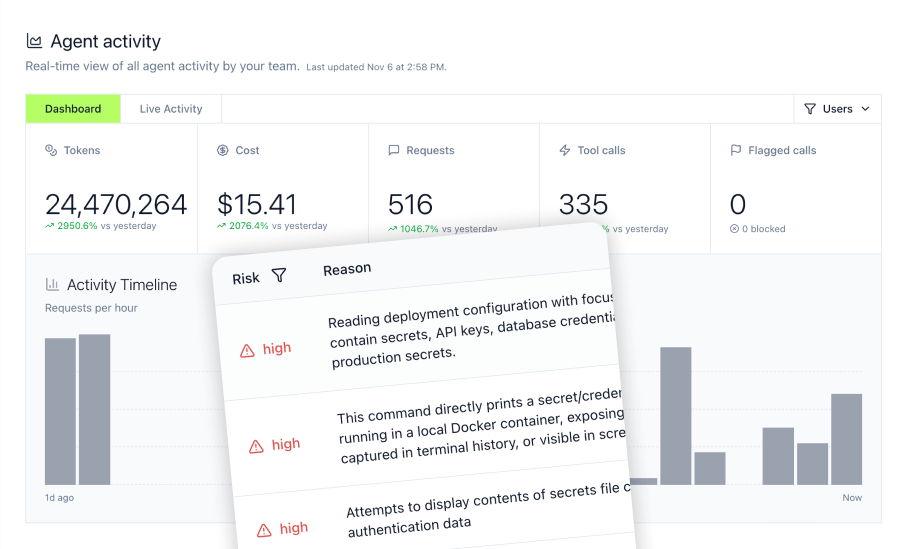
Mintive addresses this through its Agent Monitor, which captures supported MCP tool calls, commands, file activity, and prompts across governed gateway traffic and compatible coding-agent environments. The platform supports SIEM export to Sentinel, Splunk, and S3, along with OTLP streaming, enabling organizations to integrate agent activity into existing security monitoring and retention workflows.
Monitoring and Optimizing Your AI Agent Spend
Cost visibility becomes critical as AI deployments scale beyond experimentation into production workloads.
Granular Cost Tracking and Reporting
Portkey's observability layer tracks tokens, requests, and estimated costs broken out by user, session, model, and tool. Cost and request metadata can be grouped by session, helping teams investigate expensive workflows, runaway loops, or over-provisioned agents.
Request tracing and model-level observability can reduce manual troubleshooting effort by helping teams identify errors and latency bottlenecks. For teams managing multiple models across different cost tiers, this granularity enables informed optimization decisions.
Full Visibility into AI Agent Activity
Portkey's gateway observability covers traffic routed through its managed endpoints, while the broader Prisma AIRS portfolio includes AI discovery and security capabilities. Organizations evaluating shadow AI visibility should distinguish gateway request logging from additional discovery and endpoint-level monitoring capabilities.
Mintive's Agent Monitor extends visibility to capture activity from supported AI clients including Claude Code, Cursor, and Codex. This includes file reads, bash commands, and off-gateway MCP use, providing a more complete picture of agent actions across the organization.
Driving Efficiency: How Portkey Streamlines AI Deployment
Speed to deployment often determines which platforms gain traction within engineering organizations.
Accelerating AI Agent Rollouts
Portkey's SaaS model enables rapid adoption. The base URL change approach means developers can begin routing traffic through the gateway within minutes, with no infrastructure provisioning required.
Centralized model access, routing configurations, and observability can streamline model evaluation and reduce the integration work required to compare providers. The ability to swap models through configuration changes also reduces experimentation friction.
When Faster Deployment Creates Governance Gaps
Rapid deployment can be challenging when it outpaces governance controls. Organizations rolling out AI coding assistants to hundreds of developers need more than model routing; they need SSO integration, SCIM-driven access policies, and tool-level permissions.
Mintive's Virtual MCP architecture addresses this through role-based bundles that package approved tools, credentials, and policies into single governed endpoints. Coursera used this approach to deploy governed AI to 2,000 employees in weeks, with security controls in place from day one rather than bolted on after adoption.
Optimizing LLM API Costs: Portkey's Strategic Routing
For organizations consuming significant LLM API volume, routing optimization can generate meaningful savings.
Dynamic LLM Routing for Cost Efficiency
Portkey's LLM Gateway supports:
- Per-team model restrictions: Limit expensive models like GPT-4 to specific teams while allowing broader access to cost-effective alternatives
- Budget controls: Set spending limits per virtual key with automatic cutoffs
- Fallback chains: Route to cheaper models when primary providers are unavailable or rate-limited
- Caching: Reduce redundant API calls through deterministic and semantic caching
Caching can reduce model API spending by reusing responses instead of making redundant provider requests. Actual savings depend on cache-hit rates, request patterns, and model pricing.
Comprehensive LLM Usage Analytics
Model call logs include latency, token consumption, and cost estimates. This data enables teams to identify which conversations or workflows drive the most spend, informing decisions about model selection and prompt optimization.
For organizations managing AI agent costs, Mintive's Agent Monitor provides token spend tracking by model, user, agent, and session with human versus agent breakdowns, enabling chargeback-grade visibility across business units.
Enhancing Developer Experience: Portkey's Integration and Productivity Tools
Developer adoption depends on integration simplicity and minimal workflow disruption.
Seamless AI Client Integration
Portkey integrates with major development tools through base URL replacement:
- OpenAI SDK: Drop-in replacement requiring only URL and key changes
- Anthropic SDK: Same approach for Claude models
- LangChain: Integration through compatible model clients and Portkey gateway configuration
- LlamaIndex: Callback-based logging integration
This SDK compatibility reduces adoption friction for teams already using these frameworks.
Customizable Workflows for Developers
The Configs system enables declarative workflow definitions, including fallback chains, caching rules, and routing logic, without modifying application code. Developers reference configs via HTTP headers, enabling environment-specific behavior.
Portkey primarily targets developers and platform teams integrating AI models and agents into applications. Its dashboard supports configuration of routing rules, guardrails, and gateway settings without modifying application code. However, connecting applications and configuring production infrastructure can still require technical expertise.
Mintive addresses broader team enablement through Coworker Agents, hosted agents that non-technical users can trigger from Slack, with governance built in through scoped tool access and sandboxed execution.
The Future of Enterprise AI: Portkey's Vision and Roadmap (2026)
The May 2026 Palo Alto Networks acquisition fundamentally changes Portkey's trajectory.
Key Differentiators and Competitive Edge
Portkey's strengths include:
- Broad model coverage: Access to more than 1,600 models through a unified API
- OpenAI compatibility: Minimal migration friction for existing OpenAI implementations
- Open-source core: The gateway codebase is available under the MIT License, enabling self-hosted deployments
Commitment to Compliance and Data Sovereignty
Enterprise requirements for data sovereignty and compliance drove Portkey's VPC and self-hosted deployment options. Following the May 2026 acquisition, Palo Alto Networks incorporated Portkey's gateway technology into Prisma AIRS AI Gateway, which became generally available in July 2026.
The acquisition introduces several considerations for organizations evaluating Portkey:
- Standalone developer pricing: Portkey's published pricing continues to list a free Developer tier and a $49/month Production tier
- Open-source roadmap: Portkey's MIT-licensed gateway remains publicly available, while enterprise capabilities are also delivered through Prisma AIRS AI Gateway
- Enterprise procurement: Organizations should confirm current pricing, deployment options, licensing, and support terms for their intended configuration
For organizations prioritizing long-term infrastructure stability, platforms like Mintive offer vendor-neutral governance that remains useful across changing AI stacks, whether you're using Claude, Cursor, ChatGPT, Gemini, or Copilot.
Why Organizations Choose Mintive for Enterprise AI Governance
While Portkey focuses on LLM routing with extensions into MCP and agent governance, Mintive provides comprehensive AI governance purpose-built for enterprises deploying coding assistants and autonomous agents at scale.
Mintive's Agent Gateway offers first-class agent identities with independently revocable credentials, going beyond user-level attribution to track what each individual agent accesses and modifies. Every agent receives its own scoped permissions, credential set, and audit trail.
The platform's Virtual MCP architecture centralizes enterprise credentials, eliminating the need to distribute secrets across developer machines. Role-based bundles package approved tools, credentials, and policies into single governed endpoints, enabling teams to deploy AI with security controls from day one.
Key capabilities include:
- Enterprise SSO and SCIM: Automatic access provisioning and deprovisioning synchronized with identity providers
- Tool-level permissions: Granular control over which agents can access specific databases, APIs, and internal systems
- Comprehensive audit trails: Capture of supported MCP tool calls, commands, file activity, and prompts with SIEM export to Sentinel, Splunk, and S3
- AI agent monitoring: Real-time visibility into what agents are doing, including file reads, bash commands, and off-gateway activity
- Cost attribution: Token spend tracking by model, user, agent, and session with chargeback-grade visibility
Organizations like Coursera have used Mintive to deploy governed AI to thousands of employees in weeks, maintaining security and compliance while accelerating adoption. For teams evaluating AI infrastructure, Mintive complements LLM gateways by addressing the broader challenge of governing what AI agents can access and do across enterprise systems.
Frequently Asked Questions
How does Portkey's log-based pricing compare to per-request or token-based models?
Portkey's hosted pricing combines a subscription with recorded-log allowances and request-based overages. Production costs $49/month with 100K recorded logs and $9 per additional 100K requests, up to 3 million requests. Provider token charges remain separate, so a request consuming 10,000 tokens may cost more at the model-provider level than one consuming 100 tokens. On the free Developer tier, exceeding the 10K recorded-log allowance does not interrupt requests, but additional logs are not recorded.
What happens to existing Portkey implementations after the Palo Alto Networks acquisition?
Palo Alto Networks completed its acquisition of Portkey on May 29, 2026, and Prisma AIRS AI Gateway became generally available on July 16, 2026. Portkey's published Developer and Production pricing remains available, while organizations evaluating enterprise deployments should confirm current packaging, licensing, and deployment requirements. The MIT-licensed open-source gateway remains publicly available for self-hosting.
Can Portkey replace an MCP gateway for governing AI agent tool access?
Portkey provides an MCP Gateway for governing server access, tool-level permissions, authentication, credentials, and tool-call observability. Mintive's MCP Gateway also governs enterprise tool connections through Virtual MCPs, SSO, SCIM-driven access policies, and centralized credentials. Mintive's Agent Gateway extends that foundation with first-class agent identities, scoped MCP access, and independently revocable agent credentials.
What compliance certifications does Portkey offer and at what price point?
Portkey reports SOC 2 Type II and ISO 27001 assurance, while Enterprise offerings include advanced compliance options and custom BAAs for eligible healthcare organizations. Enterprise pricing is quote-based, with a $99,999 annual contract listed on AWS Marketplace. Organizations in regulated industries should evaluate their specific contractual, data residency, security, and audit requirements rather than assuming a particular subscription tier automatically establishes regulatory compliance.
How do I evaluate whether Portkey or Mintive better fits my organization's needs?
Consider three factors: Are you primarily optimizing LLM API costs and routing, or do you need governed access to enterprise tools and databases? Do you need per-agent identity with independent credential rotation, or is user-level attribution sufficient? What compliance certifications and retention requirements apply? Portkey offers LLM routing with MCP and agent governance extensions, while Mintive's platform addresses comprehensive AI governance across tools, identities, and audit trails.