Enterprises deploying AI agents at scale face a fundamental governance problem: agents operate faster than security teams can track them. As organizations roll out Claude Code, Cursor, ChatGPT, and custom agents across hundreds or thousands of employees, the need for centralized visibility, identity management, runtime protection, and compliance-grade audit trails has become critical.
The AI agent security market in 2026 reflects this urgency. Major acquisitions, including Check Point acquiring Lakera for approximately $201.8M and Cisco acquiring Astrix Security, signal that enterprise security vendors recognize agentic AI as a distinct security category requiring purpose-built solutions rather than retrofitted traditional tools. The OWASP Top 10 for Agentic Applications provides a framework for understanding these emerging threats, from prompt injection to tool poisoning and data leakage.
This guide covers the platforms security teams, CISOs, and platform engineers should evaluate when building governed AI agent infrastructure.
Key takeaways
- AI agent security platforms in 2026 divide into four primary categories: identity governance, runtime protection, enterprise platform extensions, and full-lifecycle solutions
- Per-agent identity with independent credential rotation addresses the shared-credential risk that collapses audit trails and over-privileges agents
- Runtime security must address prompt injection, tool poisoning, and data leakage across both MCP tool calls and local agent activity
- Shadow AI detection requires visibility beyond gateway traffic into local agent activity from coding tools like Cursor and Claude Code
- Acquisition activity shows enterprise security consolidation, with Palo Alto Networks acquiring Protect AI and Portkey, Check Point acquiring Lakera, and Cisco acquiring Astrix
1. Mintive: Enterprise AI agent infrastructure and governance
Mintive provides enterprise AI agent infrastructure and governance for companies deploying agents at scale. Mintive's MCP Gateway centralizes governed access to enterprise tools and data, while its Agent Gateway extends that foundation to autonomous agents through first-class identities, scoped permissions, and credential management. Its LLM Gateway supports governed model routing and usage controls.
What makes Mintive different
Mintive takes a data-permissions-first approach to AI agent governance. The platform starts with:
- SSO and SCIM-driven RBAC
- Virtual MCP Bundles with tool-level policy
- Comprehensive audit logs
- Agent Bundles with per-agent identity and scoped permissions
- Independent credential rotation
The core differentiator is the Bundle primitive: a single object that packages directory groups, curated MCP tools, security policies, and audit trails together. One Bundle per role eliminates the manual wiring required by platforms that separate plugins, access rules, and agent accounts into multiple objects. This architecture enabled teams like Coursera to deploy governed AI to 2,000 employees in weeks.
Core capabilities
- MCP Gateway: Centralized registry of 10,000+ MCP servers with one-click deployment, hosting open-source and custom STDIO-based servers in sandboxed containers
- Agent Identities: Each agent authenticates as a distinct principal with scoped tool access and independently revocable credentials, supporting bearer keys, OAuth 2.0 M2M tokens, and workload identity federation
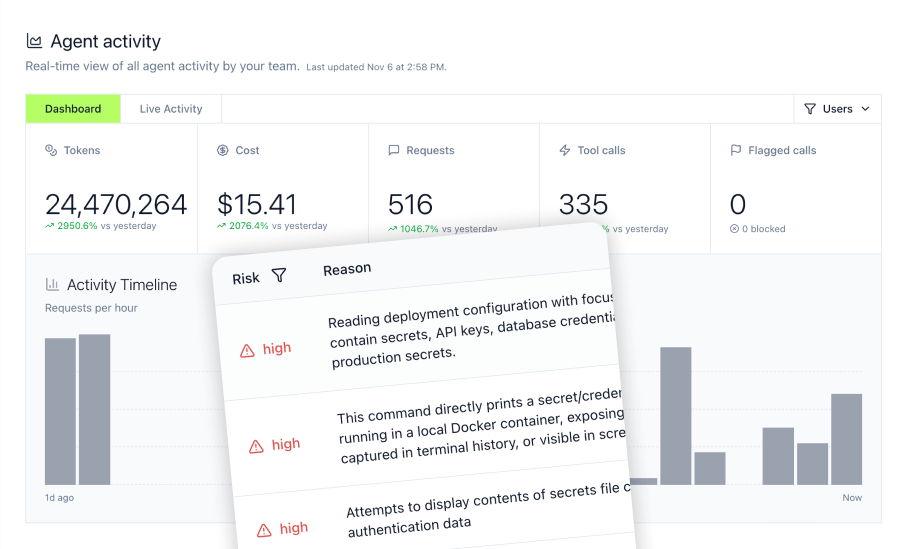
- Agent Monitor: Visibility into supported gateway and local agent activity, with SIEM export, usage and cost tracking, and session-level investigation. Coverage includes supported activity from Cursor and Claude Code, such as commands, file access, and MCP tool calls
- Guardrails: Mint Guard provides managed detection for prompt injection, PII, secrets, and harmful content. Rules support declarative policy enforcement, while Gateway Middleware provides customer-authored JavaScript for DLP integrations, redaction, and custom security controls
- Virtual MCP Bundles: Per-use-case endpoints that expose curated tool sets with SCIM-driven membership, fine-grained RBAC, and complete audit trails
Security architecture
Mintive implements defense-in-depth through multiple layers:
- SSO via Okta, Azure AD, and Google Workspace with SCIM group sync
- Tool-level permissions per Bundle with read-only and write-tool separation
- Custom JavaScript policies on every tool call running in a JS sandbox
- Private network tunnels for on-prem connectors without public exposure
- Tamper-evident access-grant history signed at write time
Enterprise integrations
The platform supports governed access to enterprise systems including Snowflake, Salesforce, GitHub, Slack, and Datadog, along with governance across Claude, Cursor, ChatGPT, Gemini, and Copilot through centralized gateway and Agent Monitor coverage.
Compliance
SOC 2 Type II audited with continuous Drata monitoring. Official technology partnerships with Cursor and Okta for cross-app access governance.
Deployment
Managed SaaS-first delivery with US and EU availability. VPC and self-hosted deployments available on request. Standard rollout takes 1 day to 3 weeks depending on policy complexity.
Pricing
Custom quotes based on team size and requirements. 7-day free trial with full feature access, no credit card required.
2. Straiker
Straiker provides a full-lifecycle AI agent security platform built around the STAR Framework covering four architectural layers: Application, Model, Tools/MCP, and Data.
Primary focus
The platform addresses the complete security lifecycle from discovery through testing to runtime defense, with three core products:
- Discover AI: Agent Security Posture Management with visibility into agents, MCP servers, skills, and tools
- Ascend AI: Red teaming engine for prompt injection and tool misuse testing
- Defend AI: Runtime security with agent kill switches and policy enforcement
3. Palo Alto Networks (Prisma AIRS)
Palo Alto Networks extended its enterprise security platform into AI agent security through strategic acquisitions, including Protect AI in 2025 for model scanning and posture management, and Portkey in 2026 for agent control plane and orchestration.
Primary focus
Prisma AI Runtime Security provides:
- Model scanning and supply chain security via Protect AI capabilities
- Agent control plane and orchestration through Portkey integration
- AI Gateway functionality added in July 2026
- Integration with existing Palo Alto enterprise security stack
4. Lakera (Check Point)
Lakera, acquired by Check Point in 2025 for approximately $201.8M, provides AI chatbot guardrails and runtime protection with an AI-native architecture rather than retrofitted traditional security.
Primary focus
The platform centers on runtime protection through:
- Lakera Guard: Real-time runtime protection with low-latency guardrails across 100+ languages
- Lakera Red: Continuous red teaming and adversarial testing
- Gandalf: Adversarial testing project with tens of millions of attack data points
5. Linx Security
Linx Security, founded in 2023, provides AI-native identity governance that unifies human, non-human, and AI agent identities in a single platform.
Primary focus
The platform addresses identity governance through:
- Identity Graph: Unified visibility across all identity types
- MCP Gateway: Inline enforcement with per-tool and per-tenant policy where models never touch secrets
- Just-in-time access: Auto-approval or human review workflows
- In-platform remediation capabilities
6. Zenity
Zenity, founded in 2021 and backed by a $125M Series C announced in August 2026, provides AI agent runtime protection and observability with intent-aware detection capabilities.
Primary focus
The platform focuses on runtime security through:
- Agent inventory and ownership attribution across platforms
- Intent-aware runtime detection correlating tool calls, memory, and control flow
- AI Security Posture Management with AIDR capabilities
- Mapping to OWASP and MITRE ATLAS frameworks
7. Strac
Strac provides AI data security across MCP tool calls, SaaS applications, browsers, and endpoints through agentless API integrations, browser extensions, and endpoint agents.
Primary focus
The platform addresses data security through:
- MCP DLP: Inspection and redaction of sensitive data in tool call responses
- Browser and Endpoint DLP: Detection of paste and upload to ChatGPT, Claude, and similar tools
- Remediation-first approach with redaction, masking, and blocking
- 50+ integrations across SaaS, browser, and endpoint
8. Microsoft (Entra Agent ID and Defender)
Microsoft extended its enterprise security platform with first-class agent identity and protection capabilities as part of the Microsoft 365 and Azure ecosystem.
Primary focus
The platform provides:
- Entra Agent ID: First-class agent identities in directory alongside human identities
- Agent 365: Centralized governance control plane
- Defender threat protection extended to AI workloads
- Native integration with Copilot Studio and Azure AI Foundry
- Purview data governance for AI usage
9. CrowdStrike (Falcon Guardian and identity security)
CrowdStrike extended the Falcon platform with AI agent identity and detection capabilities, including its completed February 2026 acquisition of SGNL for continuous identity security and just-in-time authorization.
Primary focus
CrowdStrike's AI-agent security capabilities include:
- Falcon Guardian: AI Detection and Response with visibility into agent activity and runtime enforcement at the endpoint
- Next-Gen Identity Security covering human, NHI, and AI agent identities
- Mapping of non-human identities and agents to human owners
- Unified detection across endpoint, cloud, and identity threats
- Charlotte AI for detection triage automation
10. Endor Labs
Endor Labs provides AI-accelerated development security with a focus on securing AI-generated code and governing coding agents.
Primary focus
The platform addresses development security through:
- AI Code Governance: Securing AI-generated code
- Agent Governance: Visibility into coding agents, models, and MCP tools
- Reachability-based prioritization for dependency vulnerabilities
- Coverage across developer workstations and cloud
Choosing an AI agent security platform
When evaluating AI agent security platforms, security teams should consider several factors.
Identity governance approach
Some platforms treat AI agents as extensions of human identities or shared service accounts. Platforms with per-agent identity allow:
- Independent credential rotation
- Clean audit attribution
- The ability to revoke one agent without affecting others
Runtime protection depth
Runtime security ranges from basic prompt filtering to intent-aware detection that correlates tool calls, memory state, and control flow. Consider:
- Whether protection covers only gateway traffic
- Whether visibility extends to local agent activity like file reads and command execution
Shadow AI visibility
Coding agents like Cursor and Claude Code operate on developer endpoints with extensive system access. Platforms differ in whether they can detect and govern off-gateway agent activity through hooks and monitors beyond centralized gateway traffic.
Compliance requirements
Organizations in regulated industries should evaluate applicable legal requirements, audit evidence, data protection controls, and SIEM export capabilities. SOC 2 Type II reports can support vendor assurance, while HIPAA safeguards apply where relevant. Verify audit scope, security controls, and supporting compliance documentation. The NIST AI Risk Management Framework provides guidance for governance and risk-management practices.
Deployment model
Options range from managed SaaS to self-hosted infrastructure. Consider whether you need:
- Managed deployment with pre-configured governance controls
- Full infrastructure ownership with the associated operational overhead
Deploying governed AI agent infrastructure with Mintive
For organizations seeking enterprise AI agent governance with per-agent identity, runtime protection, and compliance-grade audit trails, Mintive provides the infrastructure that makes agents deployable, governed, measurable, and swappable.
Core infrastructure components:
- MCP Gateway centralizes tool access through Virtual MCP Bundles with SCIM-driven RBAC and credential injection
- Agent Bundles give each autonomous agent its own identity with M2M authentication, scoped tools, and independent rotation
- Agent Monitor provides visibility into supported gateway traffic and local agent activity from Claude Code, Cursor, and Codex
- Mint Guard applies managed detection for prompt injection, PII, and secrets on supported tool calls, while Rules and Gateway Middleware provide additional runtime enforcement
Enterprise adoption:
Mintive serves enterprise customers including Coursera (deployed to 2,000 employees), Stability AI, Modern Treasury, DNSFilter, and Deerfield Group across healthcare, fintech, e-commerce, and SaaS sectors.
Security and compliance:
The platform holds SOC 2 Type II attestation with continuous Drata monitoring and maintains official technology partnerships with Cursor and Okta.
Visit mintmcp.com to book a demo and see how governed AI agent infrastructure deploys in days, not months.
Frequently asked questions
What is AI agent security and why does it matter in 2026?
AI agent security encompasses the identity governance, runtime protection, access control, and audit capabilities required to safely deploy autonomous AI agents at enterprise scale. As organizations move from AI experiments to production deployments with hundreds of agents accessing enterprise systems, the attack surface expands significantly. Agents can execute commands, access databases, read files, and call external APIs with minimal human oversight. Without proper governance, organizations face prompt injection attacks, data leakage, credential sprawl, and audit trail gaps that complicate SOC 2 audit readiness and compliance with applicable regulations such as HIPAA.
How do AI agent security platforms prevent prompt injection attacks?
Platforms use multiple defense layers including input validation, output screening, and runtime detection. Managed detection policies can identify high-confidence prompt injection patterns and block them before execution. More sophisticated platforms correlate tool calls, memory state, and control flow to detect intent-based attacks that may not trigger signature-based rules. DLP middleware can inspect both arguments sent to tools and results returned, redacting sensitive data or blocking suspicious requests. The most effective approaches combine proactive guardrails with comprehensive monitoring that captures attempts for security team review.
What is per-agent identity and why is it important?
Per-agent identity means each autonomous agent receives its own credentials, permissions, and audit trail rather than running on shared service accounts or repurposed human API keys. This approach enables independent credential rotation so revoking one compromised agent does not affect others, clean audit attribution showing exactly which agent performed which action, scoped permissions limiting each agent to its required tools, and compliance with least-privilege principles. Platforms like Mintive's Agent Bundles implement per-agent identity with M2M authentication and workload identity federation options.
How do platforms detect shadow AI agent usage?
Shadow AI detection requires visibility beyond centralized gateway traffic. Coding agents like Cursor and Claude Code execute locally on developer endpoints, making file reads, running bash commands, and potentially using MCP servers that bypass governed infrastructure. Effective platforms deploy lightweight hooks on endpoints that capture local agent activity including file access, command execution, MCP tool calls, and prompt submissions. This data flows to a central monitoring system where security teams gain visibility into both sanctioned and unsanctioned AI usage, with rules to flag, block, or require approval for risky actions.
Can AI agent security platforms integrate with existing enterprise security tools?
Enterprise platforms typically integrate with identity providers (Okta, Azure AD, Google Workspace) for SSO and SCIM-based access control, SIEM systems (Splunk, Sentinel, S3) for audit log export and correlation, DLP tools (AWS Bedrock Guardrails, GCP DLP, Microsoft Purview) for data protection policy enforcement, and enterprise systems (Snowflake, Salesforce, GitHub) as governed data sources. The integration depth varies by platform, with some offering pre-built middleware templates while others require custom development. Evaluate whether your required integrations are available out of the box or require additional implementation work.