The Model Context Protocol ecosystem has grown rapidly. In December 2025, the MCP project's official announcement reported more than 10,000 active servers and 97 million monthly SDK downloads, establishing an early benchmark for the protocol's adoption. Yet enterprises face a critical governance gap: public discovery registries excel at helping developers find MCP servers, but production deployments demand runtime enforcement, compliance certifications, and audit trails that public platforms were never designed to provide. Organizations deploying AI agents at scale need to understand when public discovery is sufficient and when a private enterprise MCP registry, combined with runtime governance, provides additional value for production deployments.
Key Takeaways
- Enterprise MCP adoption is growing, but production deployments still require authentication, authorization, monitoring, and audit controls that registry discovery alone does not provide
- Public registries provide MCP server discovery but do not enforce runtime access policies. GitHub's preview private-registry enforcement can be bypassed through configuration edits, while its managed-settings allowlist provides stronger controls for supported Copilot clients
- Managed enterprise MCP platforms can reduce the engineering and operational work required to build custom gateway infrastructure, although total cost depends on licensing, deployment requirements, integrations, and ongoing maintenance
- MCP security research has documented command injection, path traversal, authentication weaknesses, and critical vulnerabilities across multiple implementations, reinforcing the need for server vetting and runtime security controls
- Enterprise deployments may require SOC 2 Type II audited infrastructure, HIPAA safeguards where applicable, per-agent identity management, and tool-level RBAC. These capabilities must be evaluated across the registry, gateway, identity, and monitoring infrastructure
- Organizations like Coursera deployed governed AI to 2,000 employees in weeks using a centralized gateway approach rather than months of custom development
Understanding Model Context Protocol (MCP) Registries in Enterprise AI
What is an MCP Registry?
An MCP registry serves as a catalog and discovery layer for Model Context Protocol servers, enabling AI agents to find and connect to tools, databases, and enterprise systems. The registry tracks server metadata, connection information, and advertised capabilities, helping organizations discover and catalog MCP servers. Controlling which servers and tools agents can actually access requires separate authorization and runtime enforcement mechanisms.
Public registries function primarily as discovery platforms where developers can browse community-built servers covering tools like GitHub, Salesforce, Snowflake, and thousands of other integrations. Private enterprise registries extend discovery through organization-approved server catalogs. When combined with an enterprise MCP gateway, they can support centralized authentication, authorization, credential management, audit logging, and runtime policy enforcement.
The Role of MCP in Enterprise AI Governance
As AI agents proliferate across enterprises, MCP has become the standard protocol connecting agents to business systems. This creates significant governance challenges:
- No telemetry: Organizations lack visibility into which tools agents call and what data they access
- Scattered credentials: API keys end up on developer laptops, creating security vulnerabilities
- Missing audit trails: Compliance teams cannot satisfy SOC 2, HIPAA, or internal risk reporting requirements
- Configuration sprawl: Every developer configures every MCP server locally, creating N installations, N authentication flows, and N potential failure points
The NSA's Cybersecurity Information Sheet on MCP Security now recommends enterprises implement centralized governance controls rather than relying on decentralized discovery approaches.
GitHub's Approach to an MCP Registry: Strengths and Limitations for Enterprises
Leveraging GitHub's Developer Ecosystem
GitHub's public MCP registry provides substantial value for discovery and experimentation. GitHub hosts numerous repositories associated with MCP development, including community-built servers and reference implementations. Its public MCP Registry provides a curated discovery experience, but the number of repositories tagged with MCP topics should not be confused with the registry's server listings. For developers exploring MCP capabilities or prototyping integrations, this free resource accelerates initial exploration.
The registry integrates naturally with GitHub Copilot, offering seamless access for organizations already standardized on GitHub's ecosystem. Developers can quickly discover reference implementations and evaluate potential servers before committing to production deployments.
Inherent Limitations for Large-Scale Governance
GitHub's documentation states that its private-registry enforcement feature is in public preview and is not the recommended method for restricting MCP server access. GitHub instead recommends enterprise-managed settings through managed-settings.json, which supports stronger server allowlisting based on names, URLs, and commands in supported Copilot clients.
Critical enterprise gaps include:
- Registry enforcement limitations: GitHub's preview private-registry restrictions rely on server name or ID matching and can be bypassed through configuration edits
- Separate private registry configuration: Internal MCP servers can be cataloged through organization-managed registries rather than the public discovery catalog
- Separate access-control layers: GitHub provides enterprise identity and policy controls, but its public registry does not independently enforce per-tool permissions across all AI clients
- Runtime audit limitations: GitHub's general audit capabilities should not be confused with comprehensive, cross-client MCP tool-call observability
- Compliance scope: GitHub's broader enterprise security assurances do not automatically establish that every MCP integration satisfies an organization's regulatory and audit requirements
The Core Value Proposition of a Private Enterprise MCP Registry
Why Enterprises Need Dedicated Governance
Private enterprise registries address the fundamental mismatch between public discovery platforms and production requirements. While public registries answer "what servers exist," enterprise registries answer "which servers can this user access, with what credentials, under what policies, with full audit trails."
The Mintive MCP Gateway exemplifies this approach by providing a single governed entrypoint between AI clients and MCP servers. The key abstraction is the Virtual MCP (VMCP): multiple connectors bundled behind one endpoint with curated tools, role-based access, and centralized credential management.
Beyond Developer Convenience: Security and Compliance
Enterprise requirements extend far beyond discovery:
- Runtime enforcement: Gateway-level policies enforce access controls on traffic routed through the governed endpoint; organizations must also restrict unapproved direct connections
- Compliance assurances: SOC 2 Type II audited infrastructure and HIPAA safeguards, including BAAs where applicable, can support regulated organizations' security and compliance requirements
- Credential centralization: Secrets managed in a central vault rather than scattered across developer machines
- Tool-level permissions: Read-only versus read-write access controlled per role, not just per server
Organizations processing healthcare data, financial transactions, or other regulated information need compliance infrastructure beyond discovery platforms. For guidance on assessing data risks in MCP deployments, the MCP data risk framework provides a structured evaluation approach.
Ensuring Strong Security and Compliance with a Private MCP Registry
Advanced Runtime Security Screening
The MCP security landscape in 2026 demands proactive protection. Security research has identified command injection, path traversal, and missing authentication as recurring risks in MCP implementations. These findings come from different assessments and samples, making server vetting, least-privilege access, and runtime controls important for enterprise deployments.
Enterprise MCP governance platforms can address these risks through layered security controls. Mintive combines managed detection through Mint Guard, declarative Rules, and customer-authored Gateway Middleware for custom security policies and DLP integrations:
- Prompt injection detection: Real-time screening of tool arguments and results
- Credentials and secrets identification: Blocking sensitive data from leaving the perimeter
- PII detection and masking: Preventing personally identifiable information from being processed inappropriately
- DLP integration: Middleware templates for AWS Bedrock Guardrails, GCP Model Armor, and other enterprise security tools
Granular Access Controls and Agent Identities
Enterprise MCP deployments require distinguishing between human users and autonomous agents. Agent identities provide each AI agent with its own credentials, scoped permissions, and audit trail, separate from the human who created it.
This model enables:
- Independent credential rotation without affecting other agents or users
- Per-agent tool access restrictions aligned with least-privilege principles
- Clear audit attribution distinguishing human from agent actions
- Revocation capabilities that remove a single compromised agent without broader impact
Comprehensive Auditability for Regulatory Needs
Compliance teams need audit trails covering tool calls, credential lifecycle events, and access policy changes. A governed MCP platform can extend a private registry with these capabilities. Mintive provides:
- Tamper-evident access-grant history signed at write time, alongside platform audit records
- SIEM export through supported integrations, including OTLP and Splunk HEC
- Agent Monitor activity views and session-level investigation for supported environments
- Usage and cost tracking across supported users, agents, models, and sessions
Seamless Integration and Scalability for Enterprise AI Agents
Bridging AI Agents with Enterprise Systems
Enterprise AI deployments span multiple clients (Claude, Cursor, ChatGPT, Gemini, Copilot) connecting to diverse backend systems. A private registry provides the integration layer managing this complexity:
- Enterprise connectors: Supported integrations for tools like GitHub, Slack, Salesforce, Snowflake, and databases
- Hosted connector runtime: Mintive's MCP Gateway operates supported connector instances, reducing the infrastructure customers need to manage
- OAuth brokering: The MCP Gateway centralizes authentication handling for supported hosted or STDIO environments
- Private network tunnels: Supported private-network connectivity reaches internal systems without requiring public exposure
Flexible Deployment Options for Global Reach
Enterprises require deployment flexibility based on data residency, sovereignty, and operational requirements:
- Managed SaaS: US and EU regional options with platform-operated infrastructure
- VPC deployment: Customer-environment deployment options available on request
- Self-hosted: Self-managed deployment options available on request for organizations with specific infrastructure or sovereignty requirements
Addressing Shadow AI and Ensuring IT Governance
Identifying and Mitigating Shadow AI Risks
Locally configured MCP servers can create governance blind spots when organizations lack visibility into their use. This "shadow AI" phenomenon becomes a concern when agents access enterprise systems through unapproved or unmonitored connections.
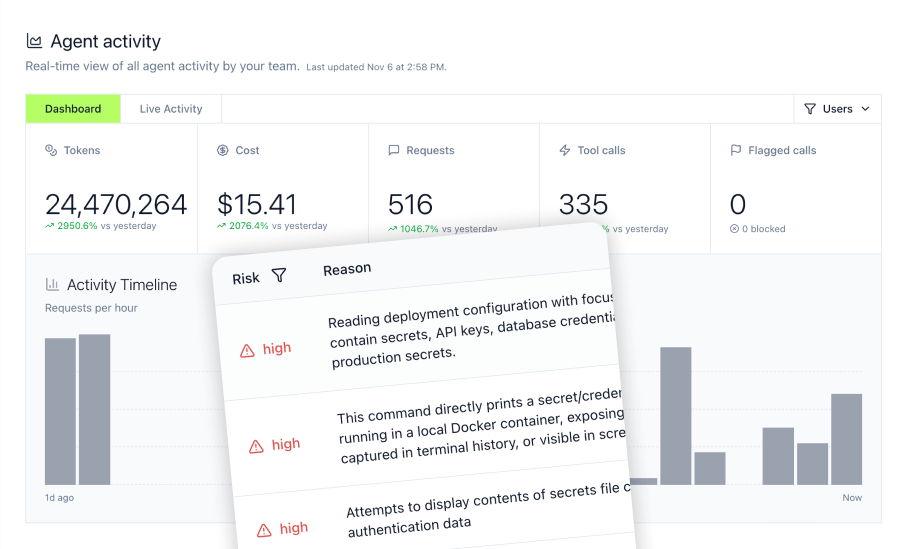
The Agent Monitor capability addresses this gap by capturing activity beyond gateway traffic:
- File reads including .env files and SSH keys
- Bash commands and package installations
- MCP tool calls captured through supported client integrations, including off-gateway activity where supported
- Prompts and context captured through supported agent integrations
Centralized Visibility Across Supported Agent Activity
Rather than relying solely on gateway logs, Agent Monitor can provide additional visibility into supported coding-agent environments, including Claude Code, Cursor, Codex, and GitHub Copilot. Available telemetry varies by integration and can include:
- Live activity feeds filterable by user, tool, and time
- Built-in detection for secrets, prompt injection, and tool permissioning issues
- Custom rules matching tool names, argument patterns, or content
- Usage and cost tracking with human versus agent breakdowns
Agent Identity and Access Management in an Enterprise Context
Distinct Identities for Each AI Agent
When enterprises scale from 10 to 100+ agents, "who did what" becomes the central governance question. Agents running on shared credentials or repurposed user API keys collapse the audit log, over-privilege the agent, and break rotation procedures.
Mintive's Agent Gateway builds on governed MCP access with first-class agent identities:
- Named, org-scoped principals: Agents exist in the same authorization model as humans
- Dedicated credentials: Each agent receives its own client ID and secret
- Scoped MCPs: Purpose-built toolsets aligned with the agent's specific function
- Independent lifecycle management: Credentials rotate without affecting other agents or users
Secure Credential Delegation and Rotation
Authentication mechanisms range from simple to highly secure:
- Bearer keys: Static keys on every request with named expiry and individual revocability
- M2M tokens: OAuth client-credentials exchange for short-lived tokens
- Workload identity federation: The agent's infrastructure (Kubernetes service account, cloud role, CI job identity) mints short-lived OIDC tokens with no secrets held by the registry
Choosing the Right MCP Registry for Your Enterprise: Key Considerations
Evaluating Deployment Speed and Ease of Use
Managed enterprise MCP platforms can reduce the engineering and operational work required to build custom gateway infrastructure. Organizations must evaluate software licensing, implementation complexity, infrastructure management, security controls, compliance requirements, and ongoing maintenance when comparing approaches.
The break-even point depends on internal engineering costs, infrastructure requirements, licensing, maintenance, and the complexity of the governance controls an organization would otherwise build and operate.
Balancing Developer Velocity with IT Control
The optimal approach treats public and private registries as complementary:
- Use public registries for discovery, experimentation, and evaluating which servers to adopt
- Deploy through private registries with governance, compliance, and audit controls for production use
- Leverage hybrid models that import selections from public catalogs while adding enterprise policy layers
Accelerating Enterprise AI Adoption with Unified Governance
The 'Bundle' Advantage for Rapid Deployment
The Virtual MCP (Bundle) primitive enables rapid deployment by packaging SCIM directory groups, curated MCP tools, custom security policies, and audit trails into a single object. One Bundle per role eliminates manual wiring of plugins, access rules, and agent accounts across systems.
Enterprise deployments illustrate the value of governed MCP infrastructure, including Mintive customer implementations and independently developed enterprise systems:
- Coursera: Deployed governed AI to 2,000 employees in weeks rather than months
- Modern Treasury: Agents save Technical Account Managers 30 minutes to 4 hours per case
- Stability AI: Company-wide deployment completed in under a month
- Pinterest: Built its own governed MCP ecosystem, reporting approximately 66,000 monthly tool invocations and an estimated 7,000 hours saved per month, based on directional calculations published by its engineering team
Real-World Impact: From Weeks to Days
Managed MCP platforms can accelerate deployment by providing hosted connectors, centralized authentication, and pre-configured governance capabilities. Actual rollout timelines depend on the organization's identity infrastructure, connector requirements, security reviews, access policies, and deployment model.
For organizations building Claude skills and workflows, the Claude skills tips guide provides practical implementation guidance aligned with enterprise governance requirements.
Why Organizations Choose Mintive for Enterprise MCP Governance
Mintive combines MCP registry discovery, runtime gateway enforcement, agent identity management, and observability in a unified enterprise governance platform. While public registries address discovery and experimentation, Mintive extends those capabilities with production-grade controls that scale from pilot teams to enterprise-wide deployments.
The platform eliminates the engineering burden of building custom gateway infrastructure while providing:
- Unified governance architecture: The MCP Gateway enforces authentication, authorization, and security policies across MCP connections routed through the gateway, with Virtual MCPs that bundle tools, roles, and policies into deployable units
- Enterprise-grade security: Mint Guard provides real-time threat detection, while custom Rules and Gateway Middleware enable DLP integration, prompt injection screening, and secrets blocking without writing infrastructure code
- Complete visibility: Agent Monitor captures activity beyond gateway traffic, including local agent behavior, file access, bash commands, and off-gateway MCP calls through supported client integrations
- First-class agent identities: The Agent Gateway extends human identity controls to autonomous agents, providing per-agent credentials, scoped permissions, independent rotation, and granular audit trails
- Compliance-ready infrastructure: SOC 2 Type II audited platform with tamper-evident logging, SIEM export, HIPAA safeguards including BAAs, and session-level investigation capabilities
Organizations across healthcare, financial services, and technology verticals choose Mintive when they need governed MCP access that satisfies security reviews, compliance audits, and operational requirements without rebuilding authentication, authorization, and observability infrastructure from scratch.
Frequently Asked Questions
How do I migrate existing MCP servers from a public registry to a private enterprise registry?
Migration typically involves identifying the MCP servers already in use, adding supported servers to the enterprise platform, and configuring access policies, credential management, and audit logging. Some platforms support importing server definitions or selecting integrations from catalogs, while others require manual configuration. Migration timelines depend on connector compatibility, authentication requirements, custom integrations, and private network access.
Can I use a private enterprise MCP registry with multiple AI clients simultaneously?
Yes, private enterprise registries can support discovery across multiple AI clients. When combined with a compatible enterprise MCP gateway, a single governed endpoint can serve Claude Desktop, Claude Code, Cursor, ChatGPT, Copilot, and custom agents. The gateway handles authentication, authorization, and audit logging for supported connections while applying role-based tool access appropriate to each user or agent identity.
What happens to my governance controls if I need to switch AI models or providers?
Enterprise MCP governance platforms can provide vendor-neutral controls that persist across supported model changes. With a model-independent gateway, identity infrastructure, permissions, audit trails, and security policies can remain in place when switching between Claude, GPT, or supported open-source models. The governance layer sits between agents and enterprise systems, rather than depending entirely on which AI model powers the agent.
How do private MCP registries handle credential rotation for connected services?
Enterprise MCP gateways can centralize credential management rather than distributing secrets to individual machines or agents. Platforms such as Mintive support credential handling for API keys, per-user OAuth, and service accounts, reducing the need to expose long-lived secrets in agent configurations. Rotation can be managed centrally, although the timing and impact depend on the authentication method and downstream service requirements.
What audit information is available for compliance reporting in regulated industries?
Enterprise MCP governance platforms can capture tool-call metadata, user or agent identity, timestamps, arguments, results, and guardrail decisions for supported traffic, subject to logging and retention settings. Mintive supports SIEM integrations through OTLP and Splunk HEC, along with tamper-evident access-grant history. These capabilities can support HIPAA audit controls where applicable and SOC 2 evidence collection, but organizations remain responsible for meeting their broader compliance requirements.