Enterprises deploying AI agents through Claude Code, Cursor, ChatGPT, and GitHub Copilot face a governance gap that traditional API gateways cannot fill. Envoy AI Gateway, renamed Agent Router in September 2026, provides Kubernetes-native AI traffic management with expanding MCP capabilities. Organizations evaluating alternatives should compare its routing and access controls with platforms offering additional agent identity, monitoring, and enterprise governance capabilities.
Traditional API gateways handle request routing, rate limiting, and authentication for REST endpoints. AI agents introduce fundamentally different requirements around tool-level governance, credential management, and identity attribution. This guide examines eight Envoy AI Gateway alternatives, with particular focus on how Mintive approaches governed data connections, first-class agent identities, managed deployment, and enterprise compliance requirements.
Key Takeaways
- AI gateways differ by scope: LLM gateways primarily govern model traffic, while MCP gateways and Agent Gateways extend governance to tool access, agent identities, and runtime policies
- MCP-native architecture matters for enterprises connecting AI agents to tools like GitHub, Snowflake, Salesforce, and internal databases through the Model Context Protocol
- Per-agent identity reduces shared-credential risks by giving autonomous agents distinct identities, scoped permissions, and attributable audit trails separate from human users
- Managed deployment can reduce operational overhead by shifting connector hosting, infrastructure maintenance, upgrades, and portions of security operations to the platform provider
- Enterprise compliance requirements should be evaluated through vendor SOC 2 Type II reports, HIPAA-related safeguards, BAA availability, audit controls, and the organization's own compliance obligations
- Shadow AI visibility requires monitoring beyond gateway traffic, capturing local tool calls, bash commands, and file access across coding agents
- Virtual MCP Bundles simplify enterprise rollouts by packaging connectors into role-based endpoints with SCIM-driven membership
Why Traditional API Gateways Fall Short for AI Agent Governance
Traditional API gateways handle request routing, rate limiting, and authentication for REST endpoints. AI agents decide which tools to call at runtime, creating governance requirements these architectures cannot address.
The core problem: Tools can appear, change, or disappear through MCP list_tools responses. Tool descriptions become an injection surface. Credentials scattered across developer laptops create security exposure, and audit trails collapse when agents run on whichever human's API key happens to be available.
What AI gateways must address:
- Tool-level governance: Which MCP servers can this role or agent access? Which specific tools within each server?
- Credential management: How are secrets injected per call without agents holding long-lived tokens?
- Identity attribution: When an autonomous agent takes an action, does the audit log trace back to the agent, or to a generic service account?
- Runtime security: How do you address prompt injection, detect PII leakage, or stop risky commands before they execute?
- Shadow AI visibility: What are developers doing with local AI tools that bypass the governed gateway entirely?
The Model Context Protocol creates a standardized way for AI clients to access enterprise tools and defines optional OAuth-based authorization for HTTP transports. However, MCP does not automatically provide centralized enterprise access policies, cross-system governance, or audit infrastructure. An MCP gateway adds those controls by sitting between AI clients and MCP servers and enforcing policies on governed tool calls.
1. Mintive: Enterprise MCP and Agent Governance
Mintive provides an enterprise control layer for AI clients and autonomous agents, built around governed data and tool connections. Mintive's MCP Gateway centralizes governed data and tool connections, while its Agent Gateway extends that foundation with first-class agent identities, scoped permissions, credentials, and attributable audit trails.
Core Capabilities
- Virtual MCP Bundles: Package connectors into role-based endpoints with SCIM-driven membership, curated tool lists, and unified audit trails. One endpoint per role eliminates the configuration sprawl of managing N users across M MCP servers
- Agent Identities: Each autonomous agent receives first-class non-human identity with its own credentials, scoped MCP access, and attributable audit trail. Credentials rotate or revoke independently from human users
- OAuth credential brokering: Mintive centrally manages downstream connector credentials and injects them into supported calls, reducing the need to expose upstream secrets directly to agents. Supports inline API keys, per-user OAuth, and per-user AWS SSO with credentials encrypted at rest
- Hosted MCP connectors: Mintive operates supported connector instances, reducing the need for teams to manage connector infrastructure. Separately, Modern Treasury reported saving 30 minutes to 4 hours per support case through governed agent access to its internal systems
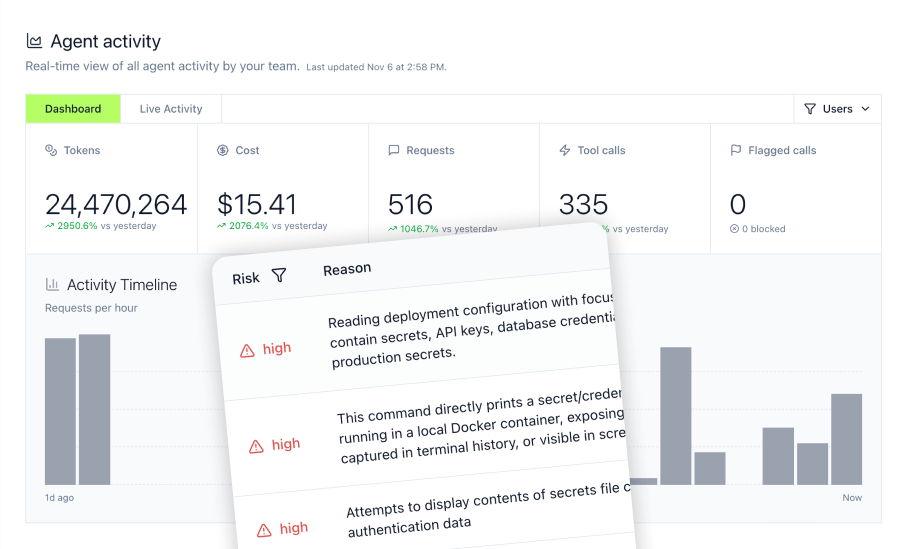
- Agent Monitor: Visibility into prompts, commands, file access, MCP tool calls, usage, and cost across Claude Code, Cursor, Codex, and GitHub Copilot. Coverage extends beyond gateway traffic to local agent activity
- Mint Guard: Managed detection policies for prompt injection, credentials, PII, and harmful content. Declarative Rules enforce conditions on tools, arguments, and content, while Gateway Middleware supports customer-authored JavaScript for DLP integrations, transformations, and custom policies
Deployment and Compliance
Mintive operates as managed SaaS in US and EU regions with VPC and self-hosted deployments available on request. The platform is SOC 2 Type II audited with HIPAA compliance and BAAs available for organizations handling PHI.
Customer Results
- Coursera deployed governed AI to 2,000 employees using Virtual MCPs to abstract setup complexity
- Stability AI went company-wide in under a month, with the Head of Security noting that Mintive "solved our most immediate MCP problems"
Pricing
Custom quotes based on team size and requirements. Per-user licensing for active AI agent users with platform fees scaling based on usage. Seven-day free trial with full feature access, no credit card required. Standard rollouts complete in one day to three weeks depending on policy complexity.
2. Bifrost
Bifrost from Maxim AI is an open-source, Go-based AI gateway for teams prioritizing low gateway overhead and infrastructure control. In a vendor-published benchmark using a t3.xlarge instance, Bifrost recorded 11 microseconds of added gateway overhead per request at 5,000 RPS with a 100% success rate. These results reflect a specific test configuration rather than typical end-to-end production latency.
Core Capabilities
- Combined LLM and MCP routing in a single Go binary
- Tool filtering to restrict which tools agents can access
- OIDC and RBAC for authentication and access control
- Virtual keys for API key management and budget controls
- Semantic caching to reduce redundant LLM calls
- Automatic failover across model providers
Deployment
Open source under Apache 2.0 license. Self-hosted only with no managed SaaS option. Enterprise tier includes clustering, VPC isolation, and air-gapped deployment support.
Considerations
Teams must operate infrastructure, manage upgrades, and implement compliance controls independently. Bifrost has a smaller GitHub community than LiteLLM, although both projects have active open-source development and ongoing releases.
3. LiteLLM
LiteLLM is a widely used open-source AI gateway with support for 100+ LLM providers. It offers an OpenAI-compatible proxy, centralized usage management, and a broad provider catalog for teams working across multiple model APIs.
Core Capabilities
- 100+ LLM provider support including OpenAI, Anthropic, Cohere, and dozens of smaller providers
- OpenAI-compatible API enabling easy integration with existing tooling
- Virtual keys for team-based access control
- Automatic failover and load balancing
- Cost tracking by user and team
- MIT licensed with no software costs for self-hosted deployment
Deployment
Self-hosted only. Enterprise tier adds SSO, SCIM, and advanced RBAC, but these features require paid licensing.
Considerations
LiteLLM supports LLM, MCP, and agent gateway capabilities, including centralized MCP access and per-key controls. Performance depends on deployment configuration, workload, and gateway implementation, while features such as SSO, SCIM, and advanced audit controls require an Enterprise license.
4. Kong AI Gateway
Kong AI Gateway builds on Kong's API management experience but now operates as a standalone AI-native gateway platform. Its architecture supports LLM, MCP, and agent-to-agent traffic, with dedicated runtime and control-plane capabilities for AI workloads.
Core Capabilities
- REST-to-MCP conversion exposing existing HTTP APIs as MCP tools
- Plugin ecosystem with 100+ existing Kong plugins for authentication, traffic management, and observability
- High throughput with a Kong-published, proxy-only benchmark reporting 859% higher throughput than LiteLLM under the tested configuration, without authentication or rate-limiting policies enabled
- Unified governance for API and AI traffic on a single platform
- Enterprise maturity with proven large-scale deployments
Deployment
Hybrid deployment with Konnect SaaS control plane plus self-hosted data plane, or fully self-hosted. AI-specific features require commercial licensing.
Considerations
Organizations should evaluate Kong's AI Gateway deployment model, commercial licensing, and identity-policy configuration against their existing infrastructure. Although Kong now supports native MCP governance, its broader API and AI connectivity architecture differs from platforms centered on internal employee and agent governance.
Pricing
AI Management Plus starts at $25/month plus usage, with resource and control-plane limits depending on the deployment configuration. Enterprise pricing is custom and billed annually.
5. Runlayer
Runlayer provides an enterprise control plane for governing MCP access, agent identities, runtime security, and AI activity across supported clients and agents.
Core Capabilities
- MCP Gateway for centralized access to approved tools and connectors
- Agent Accounts with machine-to-machine authentication and scoped policies
- Identity-aware access control for users, groups, agents, tools, and resources
- Runtime security with checks before supported tool actions execute
- Shadow AI discovery for MCP servers, skills, plugins, and client configurations
Deployment
Managed SaaS and self-hosted deployment options.
Considerations
Organizations should evaluate Runlayer's Agent Account, policy, and deployment models against their identity provider integrations, governance requirements, and operational preferences.
6. Portkey (Prisma AIRS)
Portkey, acquired by Palo Alto Networks in May 2026 and integrated into Prisma AIRS AI Gateway, provides model routing, observability, guardrails, and AI traffic governance. Its capabilities extend into MCP access management and agent security alongside its established LLM gateway features.
Core Capabilities
- Model support across 40+ providers
- Deep observability with tracing, evaluations, and prompt management
- Guardrails for content filtering and safety
- Semantic caching to reduce costs
- MIT-licensed gateway core available open source
Deployment
Hybrid with managed SaaS for control plane. VPC and compliance options available on enterprise tiers.
Considerations
Organizations should evaluate how Portkey's existing gateway capabilities integrate with Prisma AIRS, including available MCP governance, agent security, deployment options, and enterprise policy controls.
Pricing
Free tier includes 10,000 logs/month. Production tier at $49/month includes 100,000 logs. Enterprise pricing is custom.
7. Cloudflare AI Gateway
Cloudflare AI Gateway integrates AI traffic management with Cloudflare's global CDN infrastructure. The platform provides edge-optimized caching and rate limiting for AI workloads.
Core Capabilities
- Global edge network integration for low-latency AI access
- Exact-match response caching to reduce repeated model requests and provider costs
- Rate limiting with Cloudflare's traffic management
- Real-time logging and analytics
- Workers AI integration for Cloudflare's model inference
Deployment
Managed SaaS only. Requires Cloudflare account and integration with Cloudflare ecosystem.
Considerations
Focused on LLM traffic rather than MCP tool governance. Less specialized for enterprise compliance requirements than governance-first alternatives. Best suited for organizations already using Cloudflare infrastructure.
8. TrueFoundry
TrueFoundry provides a broader ML platform that includes AI gateway functionality. The platform targets ML platform teams building comprehensive AI infrastructure.
Core Capabilities
- Kubernetes-native deployment with managed control plane
- Model serving infrastructure beyond just gateway
- Virtual Account Tokens for credential management
- Cedar/OPA policy engine for declarative access control
- Air-gapped support via forward proxy
Deployment
Hybrid with managed SaaS control plane plus self-hosted data plane in customer's Kubernetes environment.
Considerations
TrueFoundry combines AI Gateway, MCP Gateway, Agent Gateway, and broader ML infrastructure capabilities. Its Virtual Account Tokens represent service identities, while its separate Agent Identity feature, documented as beta, supports registered agents with distinct credentials, scoped permissions, and attributable actions.
Total Cost of Ownership Comparison
Total cost of ownership depends on licensing, infrastructure, operational staffing, deployment requirements, security controls, and connector maintenance.
Mintive (Managed):
- Software licensing: Custom quote based on team size and requirements
- Connector infrastructure: Included for supported hosted connectors
- Operations: Managed infrastructure reduces the need for customer-operated connector runtimes
- Compliance: SOC 2 Type II audited, with compliance documentation and enterprise audit controls
Self-hosted (Bifrost or LiteLLM):
- Software licensing: Open-source capabilities available without license fees
- Infrastructure: Customer-managed hosting, compute, and networking
- Operations: Customer-managed deployment, monitoring, upgrades, and maintenance
- Compliance: Organization remains responsible for applicable security controls, assessments, and audit evidence
- Connector maintenance: Depends on the connector architecture and supporting tools
Managed platforms can reduce operational responsibilities, while self-hosted platforms provide greater infrastructure control and may offer cost advantages for organizations with established platform engineering capabilities. Organizations should compare vendor quotes and internal operating costs using the same workload and security requirements.
AI Client and Enterprise Identity Support
AI client compatibility depends on whether a gateway supports the required MCP transport, authentication flow, and client integration. Mintive and Runlayer document support for Claude Code, Cursor, ChatGPT, and GitHub Copilot. Other gateways may support these environments through LLM API routing or specific MCP configurations, but those capabilities should not be treated as interchangeable.
Organizations should validate each gateway against their actual AI clients, authentication requirements, and intended tool-access workflows.
Identity support differs significantly across gateways. Mintive's Agent Gateway provides first-class agent identities with scoped MCP access, bearer credentials, machine-to-machine authentication, and independent rotation and revocation. Runlayer supports Agent Accounts with machine-to-machine authentication and delegated access. LiteLLM offers enterprise SSO, SCIM, and virtual keys. Kong provides enterprise identity controls and identity-aware AI policies.
These models should be compared based on their identity principals, downstream credential handling, delegation support, and audit attribution rather than treating virtual API keys as equivalent to agent identities.
Mintive maintains official partnerships with Okta for cross-app access governance and with Cursor for MCP governance and visibility, demonstrating enterprise readiness through deep product collaboration.
How Mintive Delivers Governed AI Agent Access at Scale
Organizations choosing Mintive gain a complete enterprise control layer purpose-built for governed AI agent deployments. The platform addresses the full lifecycle of agent governance from identity through tool access to runtime security and compliance.
Key advantages:
- Virtual MCP Bundles eliminate N×M configuration complexity, letting administrators create role-based endpoints that automatically provision the right tools to the right teams through SCIM-driven membership
- First-class agent identities reduce reliance on shared credentials by giving autonomous agents distinct identities, scoped permissions, and attributable audit trails
- Agent Monitor extends visibility beyond gateway traffic to capture local agent activity, addressing shadow AI risks that traditional proxies cannot detect
- Managed MCP connectors shift operational burden from customer teams to Mintive's platform, with customers like Coursera deploying governed access to 2,000 employees through simplified Virtual MCP configurations
- SOC 2 Type II audited infrastructure with HIPAA-related safeguards and BAA availability supports regulated industries requiring enterprise compliance support through audited infrastructure, HIPAA-related safeguards, BAA availability, and audit-ready logs
Mintive's MCP Gateway provides access to a directory of 10,000+ available MCP servers, while the LLM Gateway routes model requests with per-team budgets and model restrictions. This unified architecture creates a single audit trail spanning tool calls, model requests, and agent behaviors across the enterprise.
Frequently Asked Questions
What distinguishes an AI gateway from a traditional API gateway?
Traditional API gateways handle request routing, rate limiting, and authentication for REST endpoints. AI gateways address AI-specific requirements around governing which tools agents can call, managing agent identities separate from human users, enforcing runtime security against prompt injection, and providing visibility into agent behavior beyond simple request logs. The Model Context Protocol creates new attack surfaces and governance needs that API management tools were not designed to address.
Why does per-agent identity matter for enterprise AI security?
When agents run on shared credentials or whichever human's API key is available, audit trails collapse into unusable noise. Per-agent identity means each autonomous agent authenticates as its own principal with scoped permissions, independent credential rotation, and attributable actions. When an agent behaves unexpectedly or becomes compromised, its credentials revoke independently without affecting other agents or human users. This becomes critical as organizations scale from a handful of agents to dozens or hundreds.
How do AI gateways detect shadow AI usage?
Shadow AI occurs when developers use local AI tools that bypass governed gateways. Detection requires visibility beyond gateway traffic into agent activity on developer machines. Mintive's Agent Monitor captures prompts, commands, file access, and MCP tool calls from supported coding agents through lightweight local hooks. This surfaces off-gateway MCP use, unauthorized tool installation, and risky behaviors that would otherwise remain invisible to security teams.
What compliance features should enterprises require from an AI gateway?
Enterprise AI gateways should provide evidence of SOC 2 Type II auditing, HIPAA-related safeguards and BAA availability where applicable, tamper-evident audit records, SIEM export capabilities, and role-based access control driven by identity provider groups. These capabilities support enterprise compliance programs, although organizations remain responsible for assessing their own regulatory requirements and maintaining the necessary controls.
Can AI gateways integrate with both internal tools and external LLM providers?
Yes. Modern AI gateways provide two integration surfaces: MCP gateway capabilities connecting agents to enterprise tools like GitHub, Snowflake, Salesforce, and internal databases, plus LLM gateway capabilities routing to model providers like OpenAI, Anthropic, and AWS Bedrock. Mintive's MCP Gateway provides access to a directory of 10,000+ available MCP servers while the LLM Gateway routes model requests with per-team budgets and model restrictions.
What are Virtual MCP Bundles and why do they simplify enterprise rollouts?
Virtual MCP Bundles package multiple connectors behind a single governed endpoint for a specific role, team, or use case. Instead of configuring each user with access to each MCP server individually (N users × M servers = N×M configurations), administrators create bundles with SCIM-driven membership, curated tool lists, and unified access policies. Users connect once to their bundle endpoint and receive exactly the tools their role requires. Coursera used Virtual MCPs to abstract setup complexity when deploying to 2,000 employees.