Enterprises deploying AI agents across Claude Code, Cursor, ChatGPT, and GitHub Copilot face a critical infrastructure decision: extend governance through an existing data and AI platform, or adopt a dedicated agent gateway focused on governing autonomous agents across multiple environments. With Databricks Unity Gateway reaching general availability in August 2026 and purpose-built agent gateways maturing rapidly, IT leaders, CISOs, and platform engineering teams must evaluate which architecture best serves their governance, security, and operational requirements. This article provides a detailed comparison to help you make an informed decision for your enterprise AI infrastructure.
Key Takeaways
- Virtual MCP Bundles provide role-based endpoints with SCIM-driven membership, curated tools, and access policies, reducing configuration overhead when deploying governed AI access across enterprise teams
- Per-agent identity management treats autonomous agents as first-class non-human principals with dedicated OAuth 2.0 credentials, scoped tool access, and independently revocable credentials
- Shadow AI detection through Agent Monitor extends monitoring beyond traffic routed through Mintive's gateway, providing visibility into supported local tool calls, bash commands, and file access from coding agents
- Cross-platform governance enables organizations to manage Claude, Cursor, ChatGPT, Gemini, and Copilot from a single control plane without platform lock-in
- Compliance-focused architecture with SOC 2 Type II audited controls, HIPAA BAA availability, and audit trails supports enterprise governance requirements, with applicable compliance coverage requiring verification across both platforms
- Deployment requirements vary by architecture: Mintive offers managed MCP connector hosting and centralized configuration, while Databricks Unity Gateway integrates with Unity Catalog and existing Databricks identity and governance controls
Understanding Enterprise AI Gateway Needs
The proliferation of AI agents across enterprise environments has created urgent governance challenges. Organizations deploy coding assistants, autonomous agents, and AI-powered workflows faster than they can implement proper controls, resulting in scattered credentials, missing audit trails, and no visibility into what agents actually access.
Agentic AI in Production
AI agents have moved beyond experimental phases into production workloads:
- Engineering teams use Claude Code and Cursor for development
- Customer success teams deploy autonomous agents for support automation
- Finance teams leverage AI for data analysis and reporting
Each deployment introduces new tool calls, data access patterns, and security considerations that traditional API management cannot address. The Model Context Protocol (MCP) has emerged as an open protocol for connecting AI agents to enterprise systems. However, MCP deployments create data risks that require careful management.
Key Governance Challenges
Enterprise teams face several interconnected problems when scaling AI agent adoption:
- No telemetry tracking which tools agents call or what data they access
- Scattered credentials with API keys on developer laptops creating exposure risks
- No access control for agents reaching connected systems without oversight
- Missing audit trails preventing SOC 2, HIPAA, or internal risk reporting compliance
- Config sprawl across every developer's local MCP server configuration
- AI unpredictability with runtime tool selection and potential injection surfaces
These challenges require identity, access control, monitoring, and risk-management capabilities suited to AI agent deployments. The NIST AI Risk Management Framework provides a vendor-neutral reference for governing, mapping, measuring, and managing AI risks.
Databricks Unity Gateway Capabilities
Databricks Unity Gateway operates as a governance layer integrated with Unity Catalog. It provides policy enforcement, cost controls, and observability for Databricks-hosted and external AI workloads routed through its services, including models, MCP servers, and supported coding agents.
Lakehouse Integration
Unity Gateway integrates tightly with Unity Catalog, treating MCP servers as catalog securables alongside tables, models, and other data assets. This integration enables organizations already using Databricks to apply existing governance patterns to AI traffic.
Key capabilities include:
- Model routing across Databricks-hosted models and external providers, including OpenAI, Anthropic, and supported cloud model services
- Budget and spend controls with monitoring, alerts, and supported enforcement options across gateway usage
- SQL-queryable usage and estimated cost data in system tables for operational reporting and spend attribution
- Payload logging through consumption-based DBU pricing
- Unity Catalog integration for centralized asset governance
For organizations already using Databricks, this approach can reuse existing Unity Catalog permissions and governance workflows, although model usage, logging, and other billed gateway features must be included in total cost calculations.
Governance Model
Unity Gateway focuses on governing AI traffic and access rather than serving as a standalone agent-hosting platform. It routes requests to internal and external models and MCP services while applying identity-based permissions, policies, rate limits, and logging. This design integrates closely with Unity Catalog while supporting external AI providers and coding agents.
Unity Gateway supports Databricks compliance security profile standards, including HIPAA-related controls in appropriately configured environments. However, it remains a managed Databricks service without a documented standalone self-hosted deployment option. Organizations should evaluate supported regions, compliance configurations, audit evidence, and deployment requirements before selecting an architecture.
Dedicated Agent Gateway Architecture
A dedicated agent gateway focuses on governing autonomous agents through first-class identities, scoped permissions, credentials, and attributable audit trails. Mintive's Agent Gateway builds on its MCP Gateway, which governs enterprise tool and data connections through Virtual MCPs, access policies, and credential handling. Its separate LLM Gateway provides governed model access and routing.
Virtual MCP Architecture
The core abstraction is the Virtual MCP (VMCP): multiple connectors bundled behind one endpoint with unified authentication, curated tool surfaces, and complete audit trails. This architecture enables:
- One endpoint per role with SCIM-driven group membership
- Tool curation limiting context-window bloat and enforcing least privilege
- Credential injection per call without connectors holding long-lived secrets
- Support for hosted, remote, custom, and STDIO connectors from a single control plane
Coursera deployed governed AI to 2,000 employees using Virtual MCPs to abstract setup complexity. Instead of 60 individual MCP configurations per person, teams connect to a single Bundle endpoint that provides exactly the tools their role requires.
Agent-First Capabilities
Purpose-built agent gateways address requirements specific to autonomous agent governance:
- Cross-platform support governing Claude, Cursor, ChatGPT, Gemini, and Copilot from unified infrastructure
- Agent-specific identity treating autonomous agents as distinct principals with dedicated credentials
- Shadow AI visibility detecting supported agent activity that bypasses gateway traffic
- Deployment flexibility offering managed SaaS, VPC, or self-hosted options based on enterprise requirements
These capabilities support organizations operating AI agents across multiple vendors, satisfying compliance audits, or requiring visibility into coding agent activity on developer machines.
Governance Through Bundles and Policies
Governance architecture represents a key difference between platform-integrated and dedicated agent gateways. The underlying primitives determine how quickly teams can deploy governed AI access and how granularly they can control agent behavior.
Bundle-Based Governance
Mintive's Bundle primitive packages SCIM directory groups, curated MCP tools, custom security policies, and audit trails into a single object. This approach differs from Unity Gateway's Unity Catalog-based governance model, which combines service permissions, tool selection, and policies. Mintive emphasizes role-specific Virtual MCP endpoints that present curated tools through a single connection.
Juan Vasquez, CTO at Deerfield Group, describes the impact: "It's as simple as adding the bundle to your Claude or Codex, and it has all the tools our IT team has already vetted. The virtual bundles are our number one feature."
Programmable Policies
Mint Guard provides managed detection policies for prompt injection, credentials and secrets, PII, and harmful content. Databricks also supports built-in guardrails, custom service policies, and external security integrations through Unity Gateway, although these service policy capabilities remain in Beta. Mintive differentiates its approach through customer-authored JavaScript Gateway Middleware, declarative Rules, and Mint Guard managed detection policies.
Beyond built-in detection, Mintive supports:
- Rules matching tool names, argument patterns, or content via regex with configurable actions
- Gateway middleware running customer-authored JavaScript for transformations, external classifiers, redaction, and custom policy enforcement
- DLP integration templates for AWS Bedrock Guardrails, GCP Model Armor, and Microsoft Purview
Christian Burrows, Head of Security at Stability AI, noted: "I'm very happy that we found Mint. It solved our most immediate MCP problems." The company deployed organization-wide governance in under a month.
Agent Identity and Credential Management
As enterprises scale autonomous agents, "who did what" becomes the central governance question. Agent identity management determines whether organizations can attribute actions, rotate credentials independently, and revoke access without affecting human users.
Preventing Credential Sprawl
Traditional approaches run agents on shared service account tokens, collapsing audit logs, over-privileging agents, and breaking credential rotation. Databricks supports user identities and service principals for automated workloads. Mintive's Agent Gateway emphasizes agent-specific identities as a core governance primitive, with dedicated credentials, scoped MCP access, independent revocation, and per-agent audit attribution.
Agent Identities treat each agent as a distinct principal:
- Named, org-scoped non-human identity in the same authorization model as humans
- Dedicated OAuth 2.0 credentials with independent rotation and revocation
- Scoped MCP access limited to the tools that specific agent needs
- Complete audit attribution showing exactly which agent performed each action
Authentication mechanisms range from bearer keys for simple deployments to workload identity federation where the agent's infrastructure mints short-lived OIDC tokens.
Downstream Credential Delegation
Downstream credentials can run as the user who triggered the agent, as a team credential, or as a provisioned service account. Where connectors require per-agent OAuth, administrators complete an "act as agent" flow that delegates permissions without exposing raw tokens. This design means revoking one agent's token stops only that agent, credential rotation does not require redeploying other agents, and audit trails clearly distinguish agent actions from human actions.
Shadow AI Detection and Observability
AI gateways only see traffic routed through them. When developers install coding agents on their laptops, run local MCP servers, or use tools outside approved channels, platform-integrated gateways have limited visibility into that activity.
Comprehensive AI Visibility
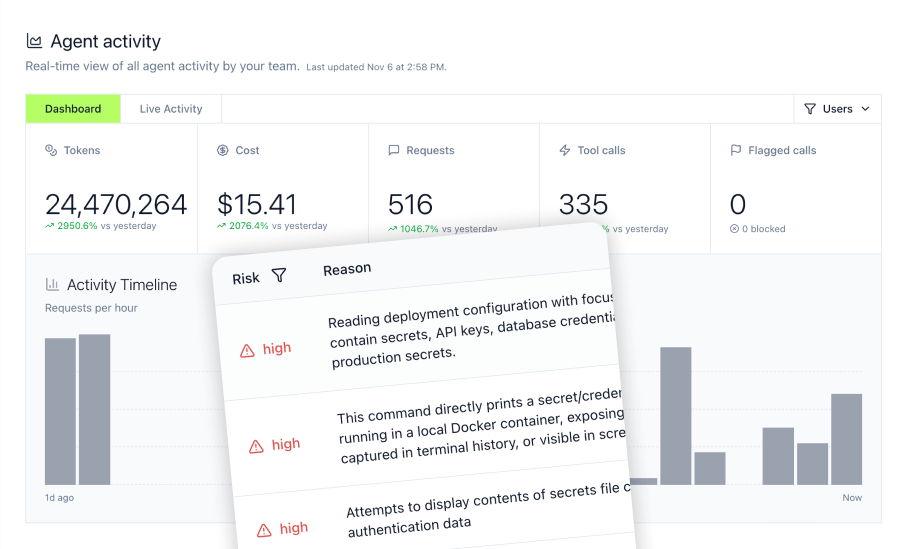
Agent Monitor captures supported activity from Claude Code, Cursor, Codex, and GitHub Copilot through lightweight local hooks. This includes:
- File reads including .env files and SSH keys
- Commands such as bash execution, package installs, and git operations
- MCP tool calls even when not routed through the gateway
- Prompts submitted to AI models
The live activity feed shows supported agent activity across connected environments, with filtering by user, tool, and time. Depending on the client and enforcement point, Rules can flag, block, ask users for confirmation, mask content, or send Slack notifications based on detected patterns.
Mitigating Unsanctioned AI Use
Shadow AI creates compliance and security risks that organizations cannot address without visibility. Agent Monitor detects MCP use even when the MCP server is not connected through the gateway, enabling security teams to:
- Identify unapproved AI tool adoption across the organization
- Detect sensitive file access by coding agents
- Track token spend and cost by model, user, agent, and session
- Export events to SIEM systems via OTLP or Splunk HEC
Ankit Kumar, Engineering Leader at Modern Treasury, reported that agents built with governed infrastructure save their Technical Account Managers 30 minutes to 4 hours per case by automating bank integration lookups.
Enterprise System Integration
Enterprise AI deployments require connections to databases, APIs, collaboration tools, and internal systems. The breadth and depth of available integrations directly impacts how quickly teams can deliver governed AI capabilities.
Connector Ecosystem
Mintive provides access to a catalog of MCP connectors with support for hosted, remote, custom, and STDIO deployment models. Key integrations include:
Data and Analytics: Snowflake, BigQuery, Databricks, dbt, PostgreSQL, MySQL, MongoDB
Engineering: GitHub, Datadog, PagerDuty, Kubernetes, Sentry
Collaboration: Slack, Zoom, Atlassian, Google Workspace
Business Operations: Salesforce, HubSpot, Zendesk, Stripe
One-click deployment allows teams to host supported STDIO-based MCP servers through Mintive's managed infrastructure, reducing the need to configure and operate connector hosting independently.
Private Network Access
Private network tunnels enable connections to on-premises databases and internal APIs without public exposure. A reverse proxy inside the customer network holds one outbound TLS connection to the gateway, making internal systems reachable with no inbound firewall rules while logging all access.
Sumesh Suvarna, CTO at Bared Footwear, observed: "The less the friction, the more the adoption, and that's where Mint came in." Internal Slack and ChatGPT integrations with governed data access enabled company-wide AI adoption.
LLM Routing and Cost Optimization
AI agents consume tokens at scale, making cost visibility and budget controls essential for sustainable deployments. The ability to route between model providers without code changes enables optimization and failover strategies.
Model Selection and Cost Controls
LLM Gateway provides a governed endpoint for supported model providers, including OpenAI, Anthropic, and Fireworks. Administrators configure:
- Per-team allowed models restricting which providers each group can access
- Policy-level budgets that stop accepting new inference requests after the configured spend limit is exceeded
- Provider swapping without requiring agent code changes
Model call logs capture latency, tokens, and cost on the same audit trail as MCP tool calls, enabling comprehensive observability across both model interactions and tool usage.
Financial Governance
The usage and cost tracking capabilities provide estimated AI spend attribution across supported models, agents, and sessions, supporting operational optimization and budget planning. Cost tracking by user, session, model, and tool helps identify runaway loops where agents consume excessive tokens, over-provisioned agents with access to expensive models they do not need, and chargeback allocation for teams using shared AI infrastructure.
Deployment Considerations
Time to value varies between deployment approaches. Organizations must balance speed of implementation against operational control and integration depth.
Implementation Approach
Mintive operates as a managed SaaS platform with data residency options in US and EU regions. Implementation follows a straightforward process:
- Connect SSO (Okta, Azure AD, Google) and enable SCIM group sync
- Import or deploy MCP servers from the catalog
- Create Bundles per role, map to directory groups, toggle tools on/off
- Distribute gateway URL to users for Claude Desktop, Cursor, Codex, or ChatGPT
- Configure middleware policies and DLP integrations
- Export audit logs to SIEM
Rollout timelines depend on policy complexity, identity integration, approved tool count, and deployment requirements.
Deployment Flexibility
For enterprises with sovereignty or infrastructure control requirements, VPC and self-hosted deployments are available on request. Organizations requiring fully air-gapped operation should verify deployment compatibility and operational requirements directly before implementation.
Why Mintive for Enterprise AI Governance
Mintive's architecture addresses the core challenges of governing autonomous agents at enterprise scale. The platform combines three specialized components into a unified governance solution:
MCP Gateway provides Virtual MCP Bundles that eliminate configuration sprawl while enforcing role-based access. Instead of managing dozens of individual MCP server connections per employee, IT teams create a single governed endpoint per role with exactly the tools each team needs.
Agent Gateway treats autonomous agents as first-class identities with dedicated credentials, independent revocation, and complete audit attribution. This prevents the credential sprawl and audit trail collapse that occurs when agents share human credentials or service accounts.
LLM Gateway governs model access across OpenAI, Anthropic, and Fireworks with policy-level budgets that block new inference requests once spending exceeds the configured limit.
Organizations gain visibility that extends beyond gateway traffic through Agent Monitor, which captures supported local tool calls, bash commands, and file access from coding agents. Gateway middleware enables custom JavaScript policies and DLP integration with AWS Bedrock Guardrails, GCP Model Armor, and Microsoft Purview.
Mintive is SOC 2 Type II audited, compliant with HIPAA standards, and offers BAAs for applicable customers alongside EU and US data residency options. The platform supports managed SaaS, VPC, and self-hosted deployments to meet diverse enterprise requirements. With 100+ MCP connectors, private network tunnels for on-premises systems, and SSO integration with Okta, Azure AD, and Google, Mintive provides production-ready enterprise AI infrastructure that scales from pilot to organization-wide deployment.
Frequently Asked Questions
How do Virtual MCP Bundles differ from traditional API access controls?
Virtual MCP Bundles package multiple capabilities into a single governance object. SCIM directory group membership determines who can access the Bundle, tool curation limits which MCP tools appear in the endpoint, security policies apply custom JavaScript or DLP integration, and audit trails capture every request. Traditional API access controls manage authentication and rate limiting but do not address AI-specific concerns like tool curation for context-window optimization or agent-vs-human attribution.
Can a dedicated agent gateway integrate with existing security tools?
Gateway middleware runs customer-authored JavaScript that can call external classifiers, DLP systems, and security tools inline during request processing. Pre-built templates support AWS Bedrock Guardrails, GCP Model Armor, and Microsoft Purview. For observability, SIEM export via OTLP or Splunk HEC sends tool calls and gateway requests to your existing security monitoring infrastructure, enabling security teams to incorporate AI agent activity into established workflows.
What happens to governance if my organization switches AI model providers?
A dedicated agent gateway maintains governance across provider changes. Since the gateway sits between AI clients and enterprise systems, switching from one model provider to another does not require rebuilding identity management, access policies, or connector integrations. LLM Gateway enables provider swapping without code changes, so teams can move between OpenAI and Anthropic while preserving budget controls and security policies.
How does Agent Monitor handle privacy when capturing coding agent activity?
Agent Monitor captures activity through lightweight hooks that run locally on developer machines. Organizations configure which events to capture based on their security and privacy requirements. Organizations should configure and review available data retention and monitoring permissions against their internal security, privacy, and compliance requirements. Administrators can manage monitoring access and supported configuration options. The goal is security visibility for high-risk behaviors.
What compliance documentation applies specifically to agent gateway operations?
Mintive is SOC 2 Type II audited and maintains continuous compliance monitoring through Drata. It is compliant with HIPAA standards and signs Business Associate Agreements for eligible customers handling protected health information. Tamper-evident audit capabilities include access-grant history signed at write time and verifiable offline through published JWKS. Organizations should review applicable SOC 2 reports, audit scope, and compliance documentation to determine which controls cover specific gateway operations and regulatory requirements.