Traditional data loss prevention was built for email gateways and file transfers. When an employee pastes customer data into ChatGPT or a developer drags proprietary code into Claude Code, that data moves through channels legacy tools were never designed to monitor. Cyberhaven Labs research found that 39.7% of data employees shared with AI tools was sensitive, while JumpCloud's Q1 2026 IT Trends research found that 61% of surveyed organizations had encountered unsanctioned or unmonitored AI tool usage among employees.
The explosion of generative AI and coding agents like Cursor, GitHub Copilot, and Claude Code creates new DLP requirements that pattern-matching regex rules cannot address. With Cyberhaven Labs reporting that 49.5% of developers used desktop coding assistants by December 2025 and enterprise adoption of endpoint-based AI agents increased 276% over the preceding year, enterprises need AI-native DLP tools that understand semantic context, protect Model Context Protocol (MCP) tool calls, and govern autonomous agents without slowing development velocity.
Key takeaways
- AI-native DLP tools use semantic analysis and small language models to detect sensitive data that pattern-matching regex misses, including trade secrets disclosed in conversational prompts
- Mintive provides enterprise AI governance through Mint Guard for prompt injection and PII detection, Gateway Middleware for external DLP integrations, and Agent Monitor for cross-platform visibility into coding agents
- MCP coverage is emerging as a critical differentiator, with tools needing to inspect Model Context Protocol traffic between AI agents and enterprise systems
- Shadow AI detection capabilities help organizations identify unauthorized AI tool usage; IBM's 2025 research found that organizations with high levels of shadow AI experienced average breach costs $670K higher than those with low or no shadow AI
- On-device classification approaches keep sensitive data local rather than routing through cloud-based classifiers
- Coding agent protection for Cursor, Claude Code, and GitHub Copilot requires endpoint-level visibility beyond browser-based DLP
1. Mintive Guardrails and Agent Monitor: Enterprise AI governance with integrated DLP
Mintive provides a governance platform for AI agents that integrates DLP capabilities through three connected layers:
- Mint Guard for managed detection policies
- Gateway Middleware for external DLP integrations
- Agent Monitor for cross-platform visibility
Rather than operating as a standalone DLP product, Mintive embeds data protection into the broader context of AI agent governance, covering tool access, identity management, and audit logging.
What makes Mintive different
Mintive's Mint Guard delivers out-of-the-box detection for:
- Prompt injection attempts
- Credentials and secrets
- PII including names, emails, phone numbers, and tax IDs
- Harmful content
The managed detection policy blocks high-confidence prompt injection attempts while logging everything else, operating in off, monitoring, or enforcing modes depending on enterprise requirements.
The Gateway Middleware layer runs customer-authored JavaScript on matching MCP tool calls and supported Agent Monitor hook events, with pre-built templates for AWS Bedrock Guardrails, Google Cloud Model Armor, OpenAI moderation, and Teleskope. Security teams can inspect, transform, mask, or block requests inline. This keeps policy enforcement in the tools enterprises already run rather than requiring a separate DLP stack.
Core capabilities
- Prompt injection protection: Mint Guard screens MCP tool arguments and connector results for prompt injection, helping detect malicious instructions that could redirect agent behavior
- PII and secrets detection: Mint Guard identifies credentials, secrets, and personally identifiable information and logs detections, while Rules and Gateway Middleware provide configurable flagging, blocking, masking, or notification where supported
- External DLP integration: Pre-built middleware templates route tool calls through existing DLP investments without requiring migration
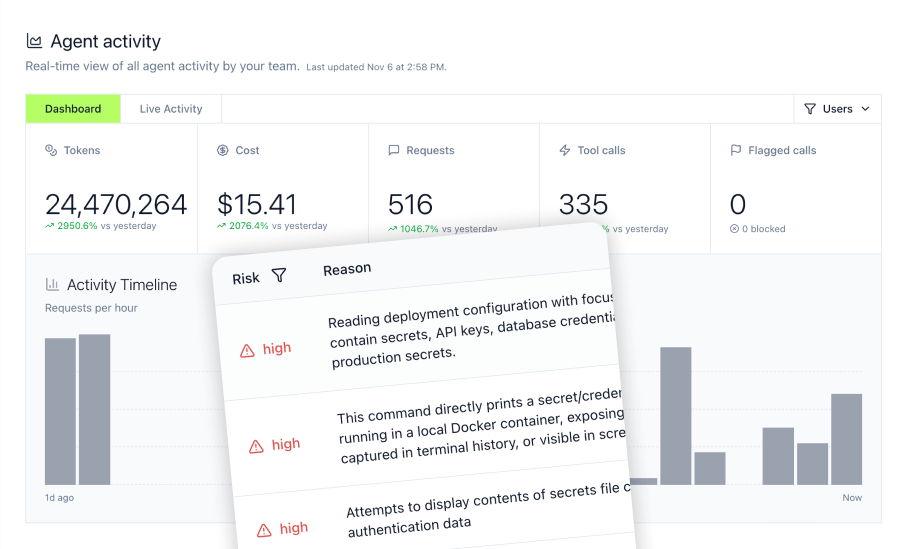
- Cross-platform agent visibility: Agent Monitor provides visibility into supported file access, including .env files and SSH keys, bash commands, MCP tool calls, and prompts from Claude Code, Cursor, Codex, and GitHub Copilot, with coverage varying by client and hook phase
- Shadow AI detection: Agent Monitor hooks report local tool calls and off-gateway MCP use into a centralized audit log, identifying unauthorized usage
- Custom policy enforcement: JavaScript sandbox runs admin-written code with access to request/response, user/agent identity, and tool metadata
Security architecture
Mintive implements defense-in-depth security through three coexisting layers:
- Mint Guard provides centrally maintained detection policies that screen every call with one toggle and nothing to author
- Rules enable declarative pattern matching on tool names, argument patterns, or content via regex
- Gateway Middleware handles bespoke logic and DLP integration for organizations with complex policy requirements
The platform routes governed MCP tool calls through centralized access controls via the MCP Gateway, providing IT and security teams visibility into which teams and agents use approved tools, when they access data, and how frequently. Agent Monitor extends visibility to supported local and off-gateway coding-agent activity.
Enterprise integrations
- Connector support for Snowflake, GitHub, Salesforce, Slack, and 100+ enterprise tools
- SIEM export via OTLP or Splunk HEC for tool calls, prompt submissions, and access policy changes
- SSO integration with Okta, Azure AD, and Google Workspace with SCIM group sync
- Pre-built DLP and classification templates for AWS Bedrock Guardrails, Google Cloud Model Armor, OpenAI moderation, and Teleskope
Compliance
SOC 2 Type II audited with continuous Drata monitoring
Pricing
Contact for enterprise demonstration and pricing
Getting started
Visit mintmcp.com/docs/mint-guard for the Mint Guard deployment guide
2. Cyberhaven
Cyberhaven operates as an enterprise AI and data security platform that tracks data from origin through every transformation to AI tool destinations. The platform focuses on data lineage as its primary differentiator, recording how information moves through an organization before reaching generative AI applications.
Primary capabilities
- Data lineage tracking from source through transformations to AI destinations
- Unified DSPM, DLP, insider risk, and AI security platform
- Native visibility into ChatGPT, Copilot, Gemini, GitHub Copilot, and Claude without proxy
- Linea AI agents for autonomous incident investigation
- Endpoint-level coverage across Windows and macOS
Deployment
Enterprise SaaS with endpoint agent deployment
3. Strac
Strac provides a unified AI DLP platform spanning browser, endpoint, SaaS, and MCP layers, with coverage for connected services including Slack, Google Drive, GitHub, and Salesforce. The platform advertises rapid deployment, with agentless SaaS integrations alongside browser and endpoint components that require separate deployment.
Primary capabilities
- MCP DLP wrapping official MCP servers with a redaction engine
- 1,700+ built-in detectors for PII, PHI, PCI, and secrets
- Browser, endpoint, and SaaS unified architecture
- Detection of sensitive data inside JPEG, PNG, and PDF uploads to AI tools
- Official Anthropic Claude Compliance API integration
Deployment
Managed SaaS with agentless integration for SaaS applications, plus browser and endpoint components
4. Nightfall AI
Nightfall AI delivers cloud-native AI data security with 100+ AI-based detection models including LLM-based file classifiers. The platform uses an API-first architecture designed for fast SaaS deployment, with native integrations for developer environments including GitHub, Jira, and Confluence.
Primary capabilities
- 100+ AI-based detection models for sensitive data classification
- MCP security for AI agent activity
- API-first architecture for rapid SaaS integration
- Native developer environment coverage for GitHub, Jira, and Confluence
- ML-based detection claiming 95% precision out of box
Deployment
Cloud-native SaaS with API-based integrations
5. Microsoft Purview
Microsoft Purview extends the Microsoft 365 compliance suite with DSPM for AI capabilities, providing native protection for M365 Copilot and third-party AI tools through browser extensions. The platform includes 300+ built-in sensitive information types and integrates with the broader Microsoft compliance ecosystem.
Primary capabilities
- Native M365 Copilot DLP and AI security
- 300+ built-in sensitive information types
- Third-party AI tool coverage via browser extension
- Unified compliance center with DLP, retention, eDiscovery, and communication compliance
- DSPM for AI generally available since 2024, with capabilities expanded through subsequent releases
Deployment
Available through eligible Microsoft 365 and Microsoft Purview licenses, including E3, E5, and applicable Purview Suite add-ons, with advanced DLP capabilities requiring appropriate licensing
6. Akamai Workforce Protector (formerly LayerX Security)
Akamai Workforce Protector provides browser-based DLP through a lightweight extension, focusing on the browser as the primary interaction point for web-based AI tools. Acquired by Akamai in 2026, the platform covers Chrome, Edge, Safari, and Firefox across Windows, macOS, and Linux.
Primary capabilities
- Browser-based DLP via lightweight extension
- Shadow AI visibility and governance
- Cross-browser coverage for Chrome, Edge, Safari, and Firefox
- Cross-OS support for Windows, macOS, and Linux
- Six-module platform covering GenAI DLP, SaaS DLP, anti-phishing, risky extensions, VPN alternative, and shadow SaaS
Deployment
Browser extension deployment
7. Symantec DLP
Symantec DLP represents the mature enterprise DLP category, now adding AI-specific capabilities through DLP 25.1 with native browser API integrations and Global Application Monitoring for desktop AI apps. The platform provides extensive pre-built regulatory templates and wide channel coverage.
Primary capabilities
- DLP 25.1 native browser API integrations for Chrome, Edge, and Firefox
- Global Application Monitoring for desktop AI applications
- Exact Data Matching, fingerprinting, and OCR
- Extensive pre-built regulatory templates
- Wide channel coverage including email, web, endpoint, cloud, and SaaS
Deployment
Hybrid with endpoint and network components
8. Forcepoint DLP
Forcepoint DLP implements risk-adaptive policies based on user risk scores, adjusting enforcement based on behavioral context rather than static rules. The platform was named a Leader in the IDC MarketScape Worldwide DLP 2025 assessment.
Primary capabilities
- Risk-adaptive DLP policies based on user risk scores
- 1,700+ predefined classifiers, templates, and policies, with compliance coverage for 80+ countries
- DSPM integration with AI-specific policy templates
- Graduated response model adjusting enforcement based on risk
- GenAI coverage via SWG and endpoint
Deployment
Enterprise deployment with endpoint and network components
9. Palo Alto Networks Prisma AIRS
Prisma AIRS extends the Palo Alto Networks security platform to AI workloads, providing full AI lifecycle security including MCP threat detection with a dedicated MCP server. The platform includes Claude Code protection through inline hook-based security checks that can stop unsafe prompts and tool execution when threats are detected.
Primary capabilities
- MCP threat detection with dedicated MCP server
- Claude Code protection through inline hook-based security checks that can stop unsafe prompts and tool execution when threats are detected
- Full lifecycle coverage for application, model, data, and agent security
- Unified AI, network, and cloud security management
- Platform consolidation for existing Palo Alto customers
Deployment
Integrated with Palo Alto Networks platform
10. Netskope
Netskope brings its SSE/CASB platform to AI DLP with 3,000+ data classifiers and app-instance awareness that distinguishes personal versus corporate AI accounts. In its 2025 Shadow AI and Agentic AI report, Netskope reported tracking more than 1,550 distinct GenAI SaaS applications.
Primary capabilities
- 3,000+ data classifiers and 1,800+ file types
- App-instance awareness separating personal from corporate AI accounts
- More than 1,550 GenAI SaaS applications tracked in its 2025 research
- Inline and API-based DLP for GenAI traffic
- DSPM plus DLP integration across SaaS, IaaS, PaaS, and on-prem
Deployment
Network-layer with proxy architecture
Choosing AI DLP for enterprise AI governance
Enterprises rolling out AI agents faster than they can govern them need DLP capabilities embedded in the broader context of AI governance, aligned with risk management principles such as the NIST AI Risk Management Framework. Mintive addresses this challenge by integrating three complementary layers into a unified platform:
Core protection layers:
- Mint Guard delivers managed detection for prompt injection, PII, credentials, and harmful content
- Gateway Middleware enables external DLP integrations through pre-built templates for AWS Bedrock Guardrails, Google Cloud Model Armor, and other services
- Agent Monitor provides cross-platform visibility into Cursor, Claude Code, and GitHub Copilot activity
Enterprise capabilities:
The combination of prompt injection protection, PII and secrets detection, and external DLP integration through pre-built templates allows organizations to enforce policy without migrating away from existing security investments. Agent Monitor extends visibility beyond browser and gateway traffic to capture file reads, bash commands, and MCP tool calls from coding agents operating locally.
Unified governance infrastructure:
For organizations evaluating AI DLP, Mintive provides the infrastructure to make agents deployable, governed, measurable, and swappable. The platform covers tool access controls, agent identity management, audit logging, and compliance monitoring in one integrated system. This addresses the unique data protection requirements of generative AI and coding agents while maintaining compatibility with existing security tools.
Visit mintmcp.com/docs/mint-guard to explore how Mint Guard, Gateway Middleware, and Agent Monitor address enterprise AI governance requirements.
Frequently asked questions
How do AI DLP tools differ from traditional DLP solutions?
Traditional DLP often relies on pattern matching, predefined classifiers, and content inspection, which can struggle to recognize sensitive conversational context. Modern DLP platforms may also support browser and endpoint monitoring, but semantic classification can improve detection of unstructured information that static rules miss. AI-native DLP tools use semantic analysis and small language models to interpret intent behind prompts. A prompt disclosing a planned acquisition at a specific dollar figure contains no regex-matchable pattern, but semantic DLP recognizes the material trade secret. AI DLP tools also address new attack surfaces like MCP tool calls, prompt injection, and coding agent file access that traditional solutions never anticipated.
Can AI DLP solutions prevent prompt injection attacks?
Specialized AI DLP tools include prompt injection detection that screens both inputs from users and outputs from AI systems. Mint Guard blocks high-confidence prompt injection attempts while logging borderline cases for review. Tool poisoning attacks, where malicious tool descriptions inject instructions into agent prompts, require additional protections for MCP tool discovery and descriptions. Screening tool arguments and connector results helps address related prompt injection risks but does not independently prevent tool-description poisoning. Protection requires defense-in-depth across the AI client to LLM communication, LLM to MCP server communication, and MCP server to external API communication.
How does a unified gateway improve AI DLP effectiveness?
Without centralized gateways, organizations face fragmented security policies across dozens of individual MCP servers, zero visibility into which agents access which tools, duplicated authentication logic, and inconsistent logging. A unified gateway transforms the exponentially complex N-to-N mesh into a manageable 1-to-N hub-and-spoke model. DLP policies apply consistently across governed MCP traffic, audit trails capture tool invocations routed through the gateway, and security teams gain visibility into connected data flows. Agent Monitor can extend visibility to supported local and off-gateway activity, although coverage depends on the client and integration.
What is shadow AI and how can DLP tools help detect it?
Shadow AI refers to unauthorized AI tool usage that bypasses corporate security controls, including personal ChatGPT accounts, unapproved coding assistants, and local MCP servers not routed through governance infrastructure. IBM's 2025 Cost of a Data Breach report found that organizations with high levels of shadow AI experienced average breach costs $670K higher than organizations with low or no shadow AI. Detection requires visibility beyond gateway traffic into local agent activity. Agent Monitor hooks into Cursor and Claude Code to report supported local tool calls, bash commands, and off-gateway MCP use into a centralized audit log, helping security teams identify shadow AI activity and bring it under approved governance controls.
Is it possible to customize DLP policies for specific AI agent use cases?
Enterprise AI DLP tools support customization through multiple mechanisms. Mintive's Gateway Middleware runs customer-authored JavaScript on matching MCP tool calls and supported Agent Monitor hook events with access to request/response, user/agent identity, and tool metadata. Pre-built templates route calls through existing DLP investments like AWS Bedrock Guardrails or Google Cloud Model Armor. Rules provide declarative pattern matching on tool names, argument patterns, or content. This layered approach allows organizations to enforce custom policies such as blocking supported .env file access events, redacting internal IP addresses, or restricting tool calls to approved regional endpoints while maintaining compatibility with existing security infrastructure.