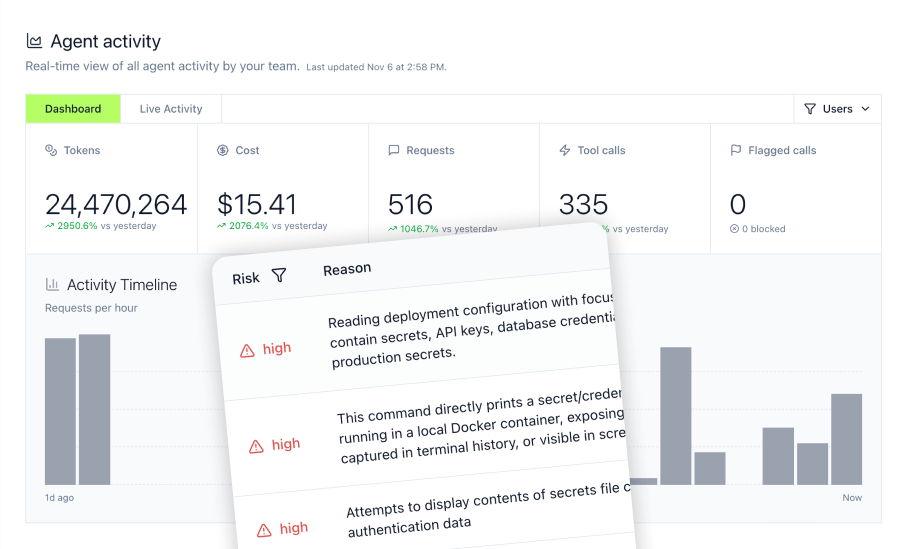
Enterprises are deploying AI agents faster than they can govern them. According to Deloitte's 2026 State of AI, only one in five companies has a mature governance model for autonomous AI agents. This oversight gap creates challenges for enterprises tracking what their AI systems access, which data they read, and what actions they take.
The right AI usage monitoring tool transforms this visibility gap into governed, auditable operations. Whether tracking coding agent activity across Claude Code and Cursor, enforcing runtime security policies, or satisfying SOC 2 audit requirements, the tools in this guide address different aspects of enterprise AI governance, from full-stack observability platforms to specialized agent monitoring solutions.
Key takeaways
- AI governance gap creates compliance risk: Only one in five companies has a mature governance model for autonomous AI agents
- Shadow AI detection is a priority: Unsanctioned AI tool usage creates security blind spots that monitoring tools can address
- Mintive provides enterprise AI agent governance with MCP Gateway, Agent Monitor, Mint Guard, SCIM-driven RBAC, per-agent identity through Agent Bundles, and SOC 2 Type II attestation
- Mintive's Agent Monitor captures coding agent activity including file reads, bash commands, MCP tool calls, and prompts across Claude Code, Cursor, and other supported environments
- Cost tracking and SIEM export enable chargeback and compliance reporting across AI deployments
1. Mintive: Enterprise AI agent governance and monitoring
Mintive provides enterprise AI agent infrastructure and governance for companies deploying agents at scale. The platform's MCP Gateway governs data and tool connections for AI clients including Claude, Cursor, ChatGPT, Gemini, and Copilot, while Agent Gateway extends governance to autonomous agents with first-class identities, scoped permissions, and audit trails.
What makes Mintive different
Mintive's data-permissions-first architecture starts from governed access through SSO, SCIM, IdP groups, Virtual MCPs, tool-level policy, and audit, then extends that foundation to autonomous agents. The platform addresses the visibility and governance gap that leaves most enterprises unable to answer basic questions about what their AI agents actually do.
Core capabilities
- Agent Monitor: Real-time visibility into coding agent activity including file reads, bash commands, MCP tool calls, and prompts captured via lightweight local hooks
- MCP Gateway: Centralized entrypoint with Virtual MCPs that bundle connectors behind governed endpoints with SCIM-driven membership and tool curation
- Agent Identities: First-class non-human principals with their own credentials, scoped permissions, and audit trails, separate from human users
- Mint Guard: Managed runtime screening for prompt injection, PII, secrets, and harmful content, with monitoring and enforcement modes
- Rules: Built-in detection for secrets and prompt injection plus custom tool-argument and regex rules with flag, block, mask, or notify actions
- Gateway Middleware: Customer-authored JavaScript running in a sandbox for DLP integrations, transformations, and policy enforcement
- SIEM Export: OTLP or Splunk HEC export for tool calls, prompt submissions, gateway requests, and access-policy changes
- Usage and cost tracking: Token spend by model, user, agent, and session with human versus agent split and cache-hit rate visibility
Security and compliance
- SOC 2 Type II attestation with continuous Drata monitoring
- Compliant with HIPAA standards, with BAAs available for customers handling protected health information
- SSO via Okta, Azure AD, Google Workspace with SCIM group sync
- Tamper-evident access-grant history signed at write time
- Official technology partnerships with Cursor and Okta
Deployment
Managed SaaS-first delivery in US and EU regions with hosted MCP connectors. VPC and self-hosted deployment available on request.
Pricing
Contact for enterprise demonstration and pricing.
Getting started
Visit mintmcp.com for the deployment guide.
2. Levo.ai
Levo.ai provides runtime-first AI monitoring and governance with eBPF-based instrumentation. The platform focuses on governing agentic AI systems in real time with privacy-first architecture.
Core capabilities
- eBPF-powered runtime visibility across AI agents, APIs, LLMs, and MCP servers
- Detection of suspicious agent behavior, identity misuse, and sensitive data exposure
- Monitoring of agent interactions, tool usage, and multi-agent workflows
- Runtime policy enforcement, AI Firewall protection, and MCP security testing
The platform provides runtime visibility, threat detection, and policy enforcement for AI agents and connected applications.
3. Datadog Agent Observability
Datadog extends its enterprise observability platform with AI and LLM monitoring capabilities. Agent Observability connects AI performance, tracing, and evaluation to infrastructure, application, and security telemetry.
Core capabilities
- LLM Chain APM traces multi-step AI pipelines with full prompt/response context
- Unified metrics combining LLM-specific data with infrastructure telemetry
- Native analysis for hallucinations, harmful content, PII leaks, and policy violations
- Enterprise-grade dashboarding and alerting
The platform maintains a 4.4/5 G2 rating based on hundreds of product reviews.
Pricing
Free tier with up to 40,000 LLM spans per month. Pro starts at $160/month with 100,000 included LLM spans and additional usage-based charges. Pricing varies by billing terms and data retention.
4. Dynatrace
Dynatrace provides AI-powered enterprise observability with automated root-cause analysis. The platform completed its acquisition of Arize AI on October 1, 2026, following a $915 million cash-and-stock agreement, extending its AI observability and evaluation capabilities.
Core capabilities
- Davis AI causation engine for automated root-cause analysis
- OneAgent auto-instrumentation with zero code changes
- Grail data lakehouse for unified logs, metrics, traces, and events
- Full-stack AIOps with deterministic causal root cause from Smartscape topology
The platform serves major global enterprises and maintains a 4.5/5 G2 rating.
Pricing
Full-Stack Monitoring starts at $0.01 per memory-GiB-hour, equivalent to approximately $0.08 per hour for an 8 GiB host, under Dynatrace's consumption-based pricing.
5. Arize AI / Phoenix
Arize AI provides AI observability and evaluation with a source-available foundation through Phoenix. The platform focuses on model evaluation, drift detection, and pre-production model quality.
Core capabilities
- Built-in and custom evaluation metrics for model and agent behavior
- Data and model drift monitoring to identify changes in inputs, outputs, and performance
- Phoenix source-available under the Elastic License 2.0 (ELv2), with free self-hosting permitted subject to license restrictions
- Pre-production model evaluation alongside production tracing
6. New Relic
New Relic extends its observability platform with AI monitoring capabilities. The platform provides unified observability across applications, infrastructure, and AI workloads.
Core capabilities
- AI monitoring integrated with application performance management
- OpenTelemetry-native data collection
- Unified dashboards for AI metrics alongside infrastructure
- Cost tracking and usage analytics
7. Splunk Observability
Splunk provides enterprise observability and SIEM capabilities with AI workload monitoring. The platform connects AI observability to security event management.
Core capabilities
- AI workload monitoring integrated with SIEM
- Log management and analysis for AI systems
- Security-focused observability for AI deployments
- Enterprise search and analytics
8. Langfuse
Langfuse provides open-source LLM observability with self-hosting options. The platform focuses on developer-friendly tooling for LLM application monitoring.
Core capabilities
- Open-source LLM observability
- Self-hosting and cloud deployment options
- Prompt management and versioning
- Cost tracking and usage analytics
9. Helicone
Helicone provides LLM observability with a focus on logging, analytics, and cost management. The platform offers developer-friendly integration with major LLM providers.
Core capabilities
- LLM request logging and analytics
- Cost tracking and optimization
- Latency monitoring
- Integration with major LLM providers
10. LangSmith
LangSmith provides observability for LangChain-based applications with tracing and debugging capabilities. The platform offers tight integration with the LangChain ecosystem.
Core capabilities
- Tracing for LangChain applications
- Debugging and testing tools
- Prompt management
- Evaluation capabilities
Choosing the right AI monitoring approach
Selecting an AI usage monitoring tool depends on your organization's governance maturity, technical requirements, and compliance obligations.
Governance versus observability
Full-stack observability platforms like Datadog and Dynatrace extend existing infrastructure monitoring to AI workloads. Specialized AI governance platforms like Mintive focus specifically on agent identity, tool-level access control, and audit trails designed for AI deployments. The choice depends on whether you need AI-specific governance primitives or unified infrastructure visibility.
Shadow AI detection
Organizations concerned about unsanctioned AI usage need tools that provide visibility beyond gateway traffic. Mintive's Agent Monitor uses hooks in supported coding agents like Claude Code and Cursor to capture file reads, bash commands, and MCP tool calls, including supported activity that bypasses centralized gateway infrastructure. Coverage depends on the client, configuration, and available hooks. This addresses the shadow AI challenge that creates security blind spots.
Runtime protection versus post-deployment analytics
Some tools focus on real-time policy enforcement while others emphasize post-deployment analysis. Mintive's Mint Guard and Rules provide runtime screening and blocking, while platforms like Arize AI focus on model evaluation and drift detection. Consider whether you need inline protection or analytical capabilities.
Compliance and audit requirements
Organizations in regulated industries need tools that provide audit trails, SIEM integration, and compliance documentation. The NIST AI Risk Management Framework emphasizes ongoing monitoring, documented governance, and risk management throughout the AI lifecycle. Mintive's tamper-evident audit logs, SOC 2 Type II attestation, and alignment with HIPAA standards, with BAAs available for customers handling protected health information, support these requirements. Evaluate whether your tools provide the compliance infrastructure your industry requires.
Enterprise AI agent governance with Mintive
For enterprises deploying AI agents across Claude, Cursor, ChatGPT, and other platforms, Mintive provides the governance layer that makes those systems deployable, governed, measurable, and swappable.
The platform addresses critical enterprise requirements:
- Governed tool access: MCP Gateway connects agents to enterprise tools through Virtual MCPs with SCIM-driven membership and tool-level policy
- Agent identity: Agent Bundles give each agent first-class credentials, scoped permissions, and separate audit trails from human users
- Activity visibility: Agent Monitor captures file reads, bash commands, MCP tool calls, and prompts across supported coding agents
- Runtime protection: Mint Guard provides prompt injection and sensitive content screening, while Rules enforce custom command restrictions
- Compliance infrastructure: SOC 2 Type II attestation, tamper-evident audit logs, and SIEM export for compliance reporting
With enterprise customers like Coursera, Stability AI, and Modern Treasury already in production, Mintive addresses the AI governance gap that leaves most organizations without visibility into their AI agent activity.
Visit mintmcp.com to explore the platform.
Frequently asked questions
What is AI usage monitoring and why is it critical for enterprises?
AI usage monitoring provides visibility into what AI agents and users actually do: which tools they access, which data they read, which commands they execute, and how much they spend. Without monitoring, organizations face security blind spots, compliance gaps, and uncontrolled costs. Deloitte's finding that only one in five companies has mature autonomous-agent governance highlights the oversight challenges organizations face, although governance maturity does not directly measure monitoring coverage.
How do AI monitoring tools help prevent shadow AI?
Shadow AI occurs when employees use unsanctioned AI tools without IT visibility. Monitoring tools address this by capturing AI activity across supported environments. Mintive's Agent Monitor uses hooks in supported coding agents like Claude Code and Cursor to capture file reads, bash commands, and MCP tool calls, including supported activity that bypasses centralized gateway infrastructure. Coverage depends on the client, configuration, and available hooks, providing visibility into off-gateway usage.
Can AI monitoring solutions integrate with existing enterprise security infrastructure?
Enterprise AI monitoring tools typically integrate with identity providers (Okta, Azure AD, Google Workspace), SIEM systems (Splunk, Sentinel), and observability platforms. Mintive provides SSO/SCIM integration, OTLP and Splunk HEC export for SIEM, and API access for custom integrations. Evaluate whether tools support your existing security stack before deployment.
What are the key features to look for in an enterprise AI monitoring tool?
Key features include audit logging with immutable records, cost tracking by user/agent/model, runtime security screening, SIEM export, SSO and RBAC integration, and coverage across multiple AI clients and agents. For organizations deploying autonomous agents, look for per-agent identity and credential management. Compliance certifications like SOC 2 Type II attestation matter for regulated industries.
How do these tools ensure compliance with data privacy regulations?
Compliance-focused AI monitoring tools can provide audit trails for captured tool calls and data access events, role-based access controls tied to identity providers, runtime screening for PII and sensitive data, and exportable logs for audit documentation. Coverage depends on the monitored systems and configured integrations. Mintive's tamper-evident audit logs, SOC 2 Type II attestation, and alignment with HIPAA standards, with BAAs available for customers handling protected health information, support these requirements. Evaluate the specific compliance certifications each tool provides against your regulatory obligations.