When evaluating enterprise AI gateway options, the decision centers on whether an organization needs a general API management platform extended for AI or a purpose-built solution for AI agent governance. Kong offers mature API gateway infrastructure with AI and MCP capabilities, while enterprises deploying AI agents across Claude Code, Cursor, ChatGPT, and Copilot may prioritize specialized MCP governance, per-agent identity management, and visibility beyond gateway traffic.
This guide examines leading enterprise AI gateway platforms, focusing on how Mintive approaches enterprise AI agent governance through managed MCP infrastructure, first-class agent identities, and monitoring beyond gateway traffic. Organizations need different capabilities depending on whether they're managing API traffic, governing autonomous agent deployments, or combining both requirements under unified infrastructure.
Key Takeaways
- Mintive focuses on enterprise MCP and agent governance with hosted connectors, Virtual MCPs for role-based access, and per-agent identity management that treats autonomous agents as first-class principals
- MCP Gateway architecture provides centralized management for Model Context Protocol servers, with a directory of 10,000+ MCP servers and supported hosted, remote, custom, and STDIO connectors
- Agent Gateway and Agent Identities deliver first-class non-human principals with scoped MCP access, bearer credentials, M2M authentication, workload identity federation, and independent credential rotation
- Mintive is SOC 2 Type II audited, compliant with HIPAA standards, and penetration tested, with BAAs available for customers handling protected health information
- Agent Monitor provides visibility into supported agent activity with audit trails, SIEM export, usage and cost tracking, and session-level investigation
- Shadow AI visibility extends beyond gateway traffic through supported integrations in Cursor and Claude Code
- Deployment models range from fully managed SaaS to self-hosted open source options
Understanding Kong AI Gateway
Kong AI Gateway extends Kong's established API management platform to handle AI workloads. Kong built its reputation on API gateway infrastructure and serves enterprise customers across industries, with an established open-source gateway project and commercial API management platform. Kong introduced AI Gateway capabilities in 2024 and subsequently expanded the platform with AI-specific routing, authentication, policy controls, and MCP support. AI Gateway 2.x introduces first-class entities for models, providers, MCP servers, and agents.
Key Kong Capabilities:
- Mature API gateway heritage with production experience across enterprise customers
- Unified control plane for API and AI traffic through Konnect
- Plugin ecosystem with hundreds of community and enterprise options
- Gateway architecture designed to support scalable API and AI traffic management
- Support for major AI providers including OpenAI, Anthropic, Amazon Bedrock, Azure OpenAI, Google Gemini, and others
Considerations:
- Some enterprise security, administration, and deployment capabilities require Enterprise licensing
- Kong supports MCP through its AI MCP Proxy plugin in Kong Gateway deployments and first-class MCP Server entities in AI Gateway 2.x
- Self-hosted and hybrid deployments require infrastructure management, while managed serverless options reduce operational overhead
- Usage-based pricing includes $100/month per proxied model, with additional charges depending on gateway configuration and analytics usage
Kong AI Management Plus starts at $25/month plus usage. Serverless AI gateways carry a $25/month control plane fee and $100/month per proxied model, with up to five models on Plus. Request analytics include the first million requests per month, with $20 per additional million. Enterprise pricing is custom and billed annually.
1. Mintive
Mintive provides enterprise AI agent infrastructure and governance as a managed SaaS platform. The platform sits between supported AI clients and enterprise systems, enforcing authentication, authorization, audit logging, and security policies on gateway-routed interactions. Agent Monitor extends visibility to supported agent activity beyond gateway traffic. Unlike Kong's broader API management orientation, Mintive focuses on governed enterprise tool access through its MCP Gateway. Its Agent Gateway builds on that foundation with first-class identities, scoped permissions, credentials, memory, and monitoring for autonomous agents.
MCP Gateway Architecture
- MCP Gateway provides centralized management for Model Context Protocol servers, a directory of 10,000+ MCP servers, and supported hosted, remote, custom, and STDIO connectors for enterprise tools and data sources
- Virtual MCP Bundles package SCIM directory groups, curated MCP tools, custom security policies, and audit trails together into one endpoint per role
- Hosted MCP Connectors operated by Mintive reduce the need to operate connector infrastructure independently, with supported integrations including Snowflake, Salesforce, GitHub, Gmail, Figma, and Atlassian
- One endpoint per role simplifies configuration versus individual connector setup for each user
Agent Gateway and Identity Management
- Agent Gateway and Agent Identities provide first-class non-human principals with scoped MCP access, bearer credentials, M2M authentication, workload identity federation, and independent credential rotation and revocation
- When an agent is compromised or decommissioned, credentials revoke independently without touching users or other agents
- OAuth 2.0 scoped tool access enables granular permission control
- Workload identity federation supports enterprise identity provider integration
Security and Compliance
Mintive is SOC 2 Type II audited, compliant with HIPAA standards, and penetration tested, with BAAs available for customers handling protected health information. The platform supports enterprise SSO, agent-specific authentication, tool-level authorization, and tamper-evident access-grant records that support compliance reporting for regulated industries.
Runtime Guardrails:
- Mint Guard provides managed detection for prompt injection, secrets, PII, and harmful content without requiring custom policy code
- Rules provide declarative policy enforcement
- Gateway Middleware enables JavaScript-based DLP integrations, redaction, and custom controls
Data is encrypted in transit and at rest, with US and EU data residency options. Security and compliance documentation is available through Mintive's Trust Center, subject to applicable access requirements.
Observability and Shadow AI Detection
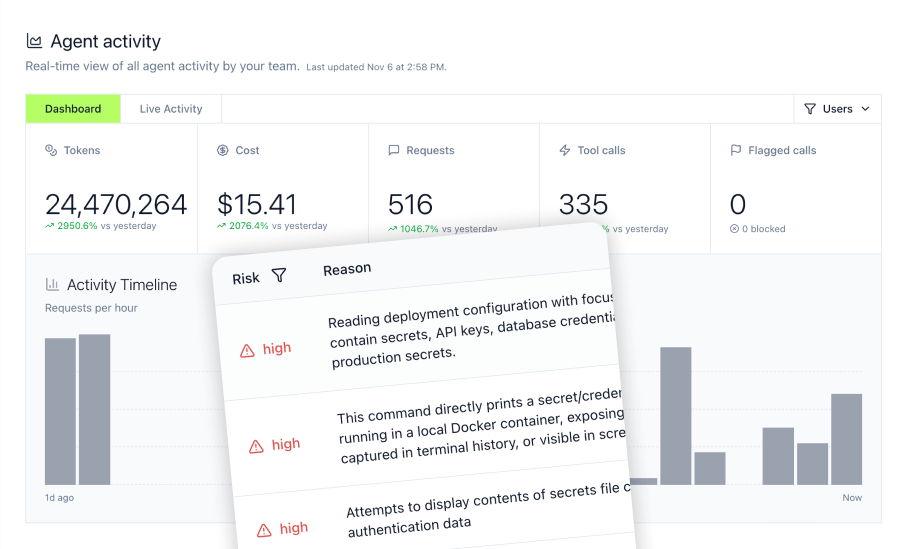
Agent Monitor provides visibility into supported coding-agent activity, including Claude Code, Cursor, and Codex integrations. Depending on the client, configuration, and hook phase, it can capture prompts, file access, commands, and MCP tool calls beyond gateway-routed traffic.
- Complete audit logging with SIEM export capabilities (OTLP, Splunk)
- Cost tracking by user, agent, model, and tool
- Session-level investigation and replay
- Administrators can deploy supported monitoring configurations through device management tools and apply available Rules to flag or block risky actions where enforcement is supported
Customer Evidence
Teams at Coursera deployed governed AI to 2,000 employees in weeks using Virtual MCP Bundles. The CTO cited the ability to "abstract away some of the complexity" as key to avoiding 60 individual MCP configurations per person. At Modern Treasury, engineering teams report agents save Technical Account Managers 30 minutes to 4 hours per case by automating bank integration lookups.
Deployment and Migration
Mintive operates as a managed SaaS platform. VPC and self-hosted deployments are available on request for enterprises with sovereignty requirements. Migration depends on the number of existing integrations, identity-provider configuration, access policies, and deployment requirements. Its managed service model reduces infrastructure setup, while more complex migrations may require additional planning.
2. Kong AI Gateway
Kong provides unified API and AI traffic management for organizations already standardized on Kong infrastructure. The platform combines API gateway capabilities with AI-specific routing, authentication, and policy controls.
Core Capabilities
- First-class AI entities for models, providers, MCP servers, and agents in AI Gateway 2.x
- MCP support through AI MCP Proxy plugin and first-class MCP Server entities
- AI Consumer identity model with OIDC and configured authentication strategies
- Plugin-based extensibility for custom transformations and integrations
Deployment Options
Kong offers both managed and self-hosted deployment models. Managed serverless options reduce operational overhead, while self-hosted and hybrid deployments require infrastructure management expertise. Organizations with existing Kong infrastructure can leverage unified control planes for API and AI traffic.
Pricing Structure
Kong AI Management Plus starts at $25/month plus usage. Model-proxy charges apply based on configuration, with request analytics including the first million requests per month.
3. Portkey (Prisma AIRS AI Gateway)
Portkey provides AI gateway infrastructure for model routing, observability, prompt management, and MCP governance. Palo Alto Networks completed its acquisition of Portkey in May 2026 and integrated its technology into Prisma AIRS AI Gateway, extending the platform's enterprise security and agent governance capabilities.
Key Capabilities
- Broad model-provider support through unified routing and fallback capabilities
- Comprehensive observability with prompt management and versioning
- Semantic caching for cost reduction on repeated queries
- MCP Gateway supports centrally governed tool access
- Service account keys, MCP access controls, and agent governance capabilities
Pricing Approach
- Developer tier: Free with 10,000 logs/month, 3-day retention
- Production tier: $49/month for 100,000 logs plus applicable overages
- Enterprise tier: Custom pricing for 10M+ logs/month with SSO and private cloud options
Organizations should evaluate how the transition to Prisma AIRS AI Gateway affects their deployment and operational requirements.
4. LiteLLM
LiteLLM provides an open-source AI gateway and Python SDK with a unified API for more than 100 LLM providers. Its core open-source components use the MIT license, while Enterprise features have separate licensing. The project also has an active community and has been expanding its gateway architecture, including work on a Rust implementation.
Open Source Approach
- MIT-licensed open-source core available without software licensing fees
- Zero software license cost for core functionality
- Python-native SDK plus proxy model for flexible integration
- Active community with rapid feature development
- Enterprise licensing for SSO, SCIM, administrative audit logs, and dedicated support
Deployment Considerations
Self-hosted LiteLLM deployments involve infrastructure, maintenance, monitoring, and operational costs beyond the free software license. Actual total cost depends on traffic volume, deployment architecture, existing infrastructure, and the team's operational capacity.
- Latency and throughput depend on gateway implementation, deployment configuration, and workload
- Production scalability should be evaluated against workload-specific load tests
- Teams should account for infrastructure maintenance, upgrades, incident response, and existing operational capacity when estimating total cost
5. TrueFoundry
TrueFoundry combines ML platform capabilities with AI gateway functionality, targeting organizations that need training, fine-tuning, model serving, and inference routing under unified infrastructure.
Platform Capabilities
- Unified MLOps platform for model lifecycle management
- Managed or self-hosted deployment options, including Kubernetes-based infrastructure
- Transparent per-user pricing at $25/user/month with pooled request limits
- Health-aware model routing for cost optimization
- First-class agent identity in beta, with agent credential controls and workload identity federation
Compliance and Security
- SOC 2 Type II audited controls
- HIPAA-related compliance measures and GDPR-focused data protection practices
- Flexible deployment across SaaS, self-hosted, and air-gapped environments
Pricing Structure
- Developer tier: Free for up to 3 users with 10,000 requests/user/month
- Pro tier: $25/user/month with 20,000 requests/user pooled plus applicable overages
- Enterprise tier: Custom pricing with advanced deployment options
Teams should evaluate whether they need only AI Gateway capabilities or the broader model deployment and MLOps platform. Self-hosted Kubernetes deployments require infrastructure expertise, while managed gateway plans reduce that requirement. Core AI Gateway and MCP governance offerings are proprietary, although TrueFoundry also maintains a separate open-source agent harness.
Choosing the Right Platform
Selecting the appropriate platform depends on primary governance requirements, technical expertise, and operational preferences.
- MCP-First Governance: Organizations deploying AI agents across Claude, Cursor, ChatGPT, and Copilot who need governed tool access without operating MCP infrastructure themselves may prioritize platforms with hosted connectors, Virtual MCP capabilities, and managed service models.
- Unified API and AI Management: Organizations with existing API gateway infrastructure seeking to add AI workload management may prioritize platforms offering unified control planes and plugin ecosystems.
- Open Source Requirements: Teams with strong DevOps capacity and open-source mandates may evaluate MIT-licensed core platforms, accounting for infrastructure and operational costs.
- MLOps Integration: Organizations requiring model training, fine-tuning, and serving alongside inference routing may prioritize unified MLOps platforms.
- Identity Architecture: Platforms differ in how they handle agent identity. First-class agent principals with independent credentials and revocation enable granular governance, while shared service accounts or API keys may suffice for simpler deployments.
- Compliance Posture: SOC 2 Type II audited infrastructure provides independent assurance about audited controls and documentation that can support customer security reviews and compliance preparation. Organizations handling protected health information should verify HIPAA-aligned controls and BAA availability.
Why Mintive for Enterprise AI Agent Governance
Mintive combines governed MCP access, managed infrastructure, and first-class agent identities for internal enterprise deployments. The platform's architecture addresses the specific challenges organizations face when deploying autonomous agents at scale:
- Managed MCP Infrastructure eliminates the operational burden of hosting and maintaining connector infrastructure. Hosted MCP connectors for enterprise tools reduce deployment complexity while the directory of 10,000+ MCP servers provides access to community-built integrations when needed.
- Virtual MCPs simplify role-based access control by packaging SCIM directory groups, curated tools, and security policies into single endpoints. This approach reduces configuration overhead from individual connector setup to group-based governance.
- Agent Gateway treats autonomous agents as first-class principals with their own identities, credentials, and permissions. This architectural choice enables independent credential rotation, granular OAuth 2.0 scoped access, and workload identity federation without touching user accounts or other agents.
- Visibility Beyond Gateway Traffic through Agent Monitor captures supported local activity in coding environments. Organizations gain audit trails, usage tracking, and session investigation across both gateway-routed and off-gateway agent interactions.
- Compliance-Ready Deployment with SOC 2 Type II audited infrastructure, HIPAA-aligned controls, and BAAs available for customers handling protected health information reduces audit preparation overhead and supports security reviews.
The platform's track record with enterprises like Coursera, Stability AI, and Modern Treasury demonstrates production readiness for governed AI agent deployments. Organizations can explore Mintive's MCP Gateway to evaluate how Virtual MCPs, Agent Identities, and Agent Monitor deliver the visibility and control that IT, security, and platform teams need as AI agents become integral to enterprise operations.
Frequently Asked Questions
What distinguishes Mintive's approach to MCP governance?
Mintive's MCP Gateway provides centralized management for Model Context Protocol servers with a directory of 10,000+ MCP servers and supported hosted, remote, custom, and STDIO connectors. Virtual MCP Bundles package SCIM directory groups, curated MCP tools, custom security policies, and audit trails into one endpoint per role, simplifying configuration versus individual connector setup.
How does Mintive handle agent identity management?
Agent Gateway and Agent Identities provide first-class non-human principals with scoped MCP access, bearer credentials, M2M authentication, workload identity federation, and independent credential rotation and revocation. When an agent is compromised or decommissioned, credentials revoke independently without touching users or other agents.
What compliance certifications does Mintive maintain?
Mintive is SOC 2 Type II audited, compliant with HIPAA standards, and penetration tested. BAAs are available for customers handling protected health information. Data is encrypted in transit and at rest, with US and EU data residency options. Security and compliance documentation is available through Mintive's Trust Center.
How does Agent Monitor provide visibility beyond gateway traffic?
Agent Monitor uses supported integrations and hooks in environments such as Cursor and Claude Code to capture local tool calls, commands, file access, and off-gateway MCP activity. Administrators can deploy supported monitoring configurations through device management tools and apply available Rules to flag or block risky actions where enforcement is supported. Coverage varies by client and hook phase.
What runtime security controls does Mintive provide?
Mintive's Mint Guard offers managed detection policies for prompt injection, credentials/secrets, PII, and harmful content without requiring custom policy code. Rules provide declarative policy enforcement, while customer-authored Gateway Middleware enables JavaScript-based DLP integrations, redaction, and custom controls.