When evaluating Portkey alternatives for MCP gateway infrastructure, organizations need tool-level governance alongside controls for model calls. Following Portkey's acquisition by Palo Alto Networks in May 2026, many teams are reassessing their MCP gateway strategy. While general-purpose API gateways may require MCP-specific integrations or configuration to support tool-level governance, authentication, and monitoring, MCP gateways natively understand JSON-RPC message structures and agent-specific security needs. This guide examines the top five Portkey alternatives, including how Mintive (formerly MintMCP) combines MCP and LLM gateways to govern tool and model calls.
Key takeaways
- Mintive stands out as a Portkey alternative for enterprise MCP infrastructure with SSO and SCIM-driven RBAC, tool-level allowlisting, and OAuth brokering for stdio and hosted MCP servers
- MCP gateways differ fundamentally from API gateways, requiring native JSON-RPC support and transport compatibility across stdio, Streamable HTTP, and legacy SSE deployments
- The broader Model Context Protocol market is growing rapidly, from $1.28 billion in 2025 to a projected $28.46 billion by 2035, creating significant opportunity for specialized MCP solutions
- Security gaps exist in traditional access controls for AI agent patterns, requiring MCP-specific authentication, fine-grained authorization, and continuous monitoring
- Organizations increasingly adopt federated multi-gateway approaches rather than single-vendor solutions, enabling MCP-focused platforms to complement existing API gateway investments
- Deployment speed separates leaders from laggards: Mintive supports managed SaaS-first deployment for governed MCP access, with VPC and self-hosted options available on request
What is an MCP gateway and why organizations need one
MCP (Model Context Protocol) gateways function as centralized control planes to securely, reliably, and idiomatically connect AI agents to the growing ecosystem of MCP servers. Unlike traditional API gateways optimized for stateless REST interactions, MCP gateways natively understand JSON-RPC message structures, handle MCP-specific authorization, routing, and transport compatibility requirements.
Core MCP gateway functions
- Protocol handling for MCP JSON-RPC requests across supported transports
- Session fan-out when clients send tool discovery requests
- Request routing based on tool names to correct backend servers
- Response forwarding from backend MCP servers to requesting clients
- Protocol compatibility across stateless modern MCP requests and legacy session-based connections
- Centralized authentication with OAuth 2.0, SSO, and federated identity providers
- Audit trail generation for every MCP interaction and tool invocation
Enterprise requirements driving MCP gateway adoption
The market opportunity is substantial: the broader Model Context Protocol market is projected to grow at a 37.22% CAGR through 2035. Organizations moving from LLM experimentation to production AI agent deployments face critical challenges:
- Zero telemetry into AI tool usage and data access patterns
- No request history for security review or compliance audits
- Uncontrolled access to sensitive data and production systems
- Fragmented infrastructure requiring multiple platforms for hosting, gateway, and monitoring
- Inconsistent authentication across MCP servers and AI assistants
General-purpose API gateways may require MCP-specific integrations or configuration to support tool-level governance, authentication, and monitoring.
1. Mintive: Enterprise MCP infrastructure platform
Mintive provides enterprise infrastructure for governing both the tool calls and model calls agents make. Its MCP gateway governs tool connections and agent identities, and its LLM gateway routes model calls with per-group budgets, allowed models, and provider switching. Mint Guard screens tool calls in real time, and Agent Monitor captures coding-agent activity, so both halves of agent traffic land in one audit trail. Mintive is SOC 2 Type II audited and compliant with HIPAA standards, with BAA availability for healthcare customers.
Key Mintive advantages
- MCP Gateway with Virtual MCPs bundles connectors and curated tool surfaces behind governed endpoints for teams, roles, or agents with SCIM-driven membership
- Agent Gateway gives autonomous agents first-class non-human identities with scoped permissions, credentials, and attributable audit trails
- OAuth brokering for stdio and hosted MCP servers adds enterprise authentication to MCP servers that lack native OAuth support
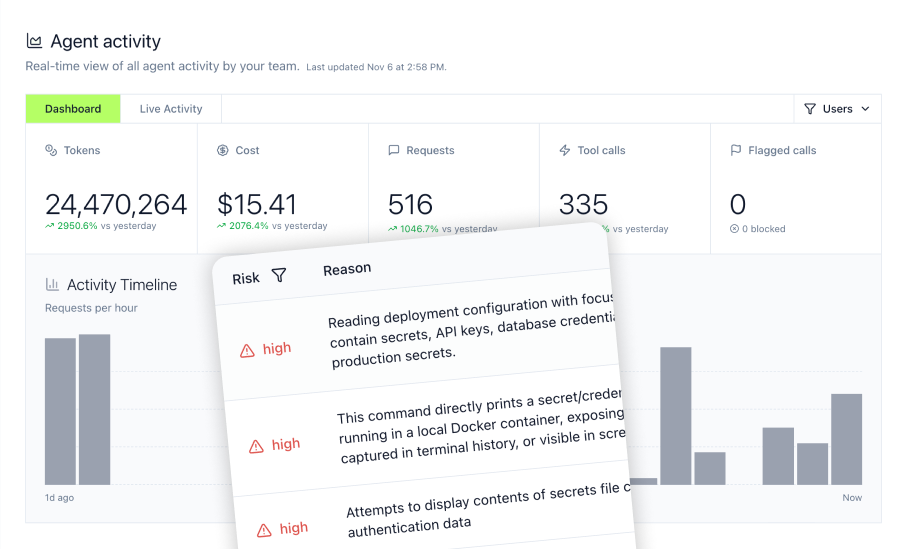
- Agent Monitor provides visibility into supported agent activity including prompts, commands, file access, MCP tool calls, usage, and token costs
- Real-time monitoring dashboards for server health, usage patterns, and security alerts
- Granular tool access control by role, with tool-level allowlisting and rule-based policy
- Complete audit logs for every MCP interaction, access request, and configuration change
Security and governance features
Mintive addresses the security gaps that traditional access controls fail to solve for dynamic agent-driven patterns. The platform provides:
- Shared and per-user authentication with flexibility for service accounts or individual OAuth flows
- SSO and SCIM-driven RBAC tied to IdP groups and Virtual MCP membership
- Centralized credential management for all MCP server API keys and tokens
- Guardrails through Mint Guard, Rules, and Gateway Middleware: Mint Guard provides managed detection policies for categories such as prompt injection, secrets, and PII. Rules enable declarative matching and enforcement. Gateway Middleware allows customer-authored JavaScript logic running in a JS sandbox for transformations, DLP integrations, and custom policy enforcement.
- Hosted MCP connectors run by Mintive with managed connector runtime, scaling, and isolation
- Two-layer governance: MCP Gateway governs traffic routed through governed MCP connections, while Agent Monitor provides visibility into supported local and agent activity beyond gateway traffic
Deployment speed and developer experience
Mintive deploys governed MCP access quickly. The platform's approach enables:
- No changes to developer workflows, maintaining existing AI assistant integrations
- Self-service access where developers request and receive tool access through governed workflows
- Pre-configured policies for common use cases
- Simple connection to MCP servers with automatic discovery and configuration
Integration ecosystem
Mintive supports governance across major AI assistants, including Claude, Cursor, ChatGPT, Gemini, and Copilot. The platform integrates with critical enterprise systems through specialized MCP connectors:
- OpenSearch MCP Server for AI-powered search, analytics, and log analysis
- Snowflake MCP Server for natural language queries against data warehouses
- Gmail MCP Server for AI-driven customer response automation
- Hosted MCP connectors run by Mintive for enterprise systems and custom use cases
Pricing and support
Mintive offers enterprise pricing with managed SaaS-first deployment in the US and EU, plus VPC and self-hosted options on request. A free trial is available. Contact enterprise@mintmcp.com for detailed pricing and deployment options tailored to your organization's needs.
2. TrueFoundry MCP gateway
TrueFoundry positions itself as a comprehensive AI infrastructure platform with MCP gateway capabilities for teams seeking unified AI infrastructure. Named a Representative Vendor in Gartner's October 2025 Market Guide for AI Gateways, the platform combines model serving with gateway functionality for organizations that already operate ML and platform infrastructure.
TrueFoundry key capabilities
- Low-latency gateway performance for latency-sensitive AI infrastructure
- Multi-region LLM gateway deployment with RBAC for model and MCP access
- Cost optimization features for cloud and model-serving infrastructure
- Self-hosted model support for running open models in-house
- Production reliability features for teams operating AI infrastructure at scale
Unified platform approach
TrueFoundry reduces context-switching by handling both model serving and gateway functions. For ML platform teams, this unified approach can simplify deployment workflows and centralize AI infrastructure operations. The platform supports Kubernetes-native deployment with air-gapped options.
Limitations to consider
- Steeper learning curve compared to specialized MCP gateways
- Requires Kubernetes expertise for optimal deployment
- Best suited for organizations already invested in ML platform and Kubernetes operations
- Platform overhead may be heavy for teams that need only MCP gateway functionality
3. IBM ContextForge
IBM ContextForge MCP Gateway brings IBM's enterprise integration patterns to the MCP ecosystem. The platform federates MCP and REST services for organizations with significant IBM infrastructure investments.
ContextForge strengths
- Enterprise integration patterns for legacy system connectivity
- Hybrid cloud support across IBM Cloud and on-premises deployments
- Watson integration for AI-enhanced capabilities
- Compliance framework alignment with established IBM security standards
- Apache 2.0 licensing for open-source MCP gateway deployments
- Multi-protocol federation supporting MCP, A2A, REST, and gRPC behind one endpoint
ContextForge limitations
- Production readiness should be evaluated directly against current IBM ContextForge documentation and release status
- Multi-vendor deployment is supported, with integration requirements varying across cloud and infrastructure environments
- Apache 2.0 licensing provides free access to core features, with optional commercial support
4. LiteLLM
LiteLLM functions as a proxy layer with multi-provider LLM routing and MCP gateway capabilities, including tool-level access controls. Its MIT-licensed open-source foundation appeals to developer-first teams comfortable with self-hosted deployment.
LiteLLM core features
- Multi-provider LLM routing with a unified API interface
- Cost tracking features for monitoring LLM spending
- Open-source foundation preventing vendor lock-in
- Self-hosted deployment for complete infrastructure control
- Rate-limiting capabilities for usage management
- Active development with weekly releases
Developer experience
LiteLLM's developer-first approach provides flexibility for teams with strong technical expertise. The platform offers extensibility through code customization and integration with existing toolchains.
Significant drawbacks
- Performance considerations: teams should benchmark LiteLLM against their own routing, streaming, and observability requirements
- Enterprise controls may require additional configuration or paid tiers for authentication, audit logging, and policy controls. SSO, RBAC, and SCIM require an enterprise license.
- Documentation depth varies by feature and may require implementation work from engineering teams
- Self-hosting burden creates operational overhead versus managed solutions
- Limited MCP-specific governance primitives compared with capabilities such as SCIM-driven Virtual MCPs, per-agent identities, tool-update policy, and laptop-level agent monitoring
5. Docker MCP gateway
Docker's MCP gateway positions as an open-source solution for orchestrating MCP servers from the Docker MCP Catalog. The platform provides centralized routing and policy enforcement with deployment via Docker Compose.
Docker MCP gateway benefits
- OSS licensing with no vendor lock-in concerns
- Docker Compose deployment both locally and in production
- Centralized MCP server discovery from Docker catalog
- Simple policy enforcement for basic access control
- Container-native architecture for organizations standardized on Docker
- OCI container per server providing strong isolation
Ideal use cases
- Development and testing environments requiring a quick MCP server setup
- Organizations committed to the Docker ecosystem with existing container infrastructure
- Teams comfortable with OSS maintenance and self-support models
- Proof-of-concept projects before enterprise deployment
Production limitations
- Managed enterprise identity workflows may require additional infrastructure for SSO, SCIM-driven RBAC, and OAuth brokering
- Built-in logs and traces available; external monitoring is optional for advanced needs
- Community support is available for the open-source gateway, while enterprise support terms should be confirmed with Docker
- Manual scaling configuration versus managed SaaS-first deployment
- Connector runtime, scaling, and patching responsibility falls on the implementing organization
Evaluating MCP gateway security and compliance features
Security and compliance capabilities separate enterprise-ready MCP gateways from basic proxying solutions. Organizations must evaluate platforms against comprehensive requirements:
Essential security requirements
- SOC 2 Type II attestation demonstrating continuous security controls
- Compliance with HIPAA standards, with BAA availability for healthcare data processing
- GDPR audit trail requirements, audit trails supporting GDPR compliance programs
- OAuth 2.0 and SSO flows for enterprise authentication
- SCIM-driven role-based access control with fine-grained permission models
- Tool-level allowlisting and rule-based policy for MCP-specific authorization
- Encryption at rest and in transit with industry-standard protocols
- Vulnerability scanning and regular security assessments
Mintive security capabilities
Mintive is SOC 2 Type II audited and compliant with HIPAA standards. Mintive signs BAAs for customers handling protected health information. The platform enforces SSO, SCIM-driven RBAC, and tool-level access control for MCP servers through its MCP Gateway and Agent Gateway products.
Authentication standards comparison
Traditional API gateways offer multiple authentication mechanisms but lack MCP-specific enhancements. MCP gateways must handle:
- Per-request authorization for MCP traffic, including tool-specific access checks
- Agent-specific access patterns rather than human user workflows
- Tool-level permissions not just API endpoint access
- Request security across MCP transports and streaming responses
Traditional access controls can struggle in LLM deployments due to dynamic, agent-driven request patterns that differ fundamentally from predictable human API usage.
MCP server deployment and hosting options
Deployment models vary significantly across MCP gateway platforms, impacting operational complexity and time-to-production.
STDIO server deployment models
STDIO-based MCP servers present unique hosting challenges that purpose-built gateways solve:
- Local execution requires running servers on every developer machine
- Containerized hosting eliminates local installation but adds orchestration complexity
- Automatic lifecycle management ensures servers start, stop, and scale appropriately
- Environment variable handling securely manages credentials and configuration
- Dependency packaging resolves library conflicts and version requirements
Mintive deployment advantages
Mintive provides managed deployment for stdio-based and hosted MCP servers with built-in hosting and automatic lifecycle management. The platform eliminates infrastructure overhead that traditional approaches impose.
Managed hosting benefits
Organizations can reduce deployment time by using managed MCP gateway platforms versus self-hosted implementations. Benefits include:
- Fast deployment versus weeks of infrastructure setup
- Automatic scaling based on demand patterns
- Reduced maintenance overhead for server management
- Built-in monitoring without a separate observability stack
- Managed SaaS-first deployment in the US and EU, with VPC and self-hosted options available on request
High availability architecture
Enterprise MCP gateways provide production-grade reliability through:
- Automatic failover when primary servers become unavailable
- Load balancing across multiple backend instances
- Health checking with automatic removal of failed endpoints
- Redundancy eliminates single points of failure
- Disaster recovery with backup and restoration capabilities
Monitoring and observability for MCP gateways
Comprehensive observability differentiates enterprise MCP gateways from basic proxy solutions. Organizations require visibility into AI agent behavior that traditional monitoring tools cannot provide.
Essential monitoring metrics
- Real-time usage dashboards showing active sessions and tool invocations
- Tool invocation tracking for every MCP tool call by the agent
- Latency metrics with p50, p95, and p99 percentile tracking
- Error rate monitoring with detailed failure analysis
- Cost analytics per team and project for chargeback
- Data access logging showing exactly what data each AI accesses
- Anomaly detection for unusual agent behavior patterns
- Performance SLA tracking against defined service levels
Mintive observability platform
Mintive's Agent Monitor provides visibility into supported agent activity beyond gateway-routed traffic. The platform tracks:
- MCP tool calls with request/response logging where configured
- Prompts, commands, and file access from supported coding agents such as Cursor and Claude Code
- Security events, including authentication failures and policy violations
- Performance metrics across MCP servers and AI assistants
- Usage analytics by user, agent, session, and model for capacity planning and chargeback
Coverage varies by supported client, agent, and hook phase. Agent Monitor extends beyond MCP Gateway traffic to provide visibility into local agent activity where supported.
Security event monitoring
Zero-trust security models for AI workloads require continuous monitoring beyond traditional authentication. MCP gateways must track:
- Agent authentication events with success/failure patterns
- Tool access attempts, including denied requests
- Data exfiltration indicators from unusual access patterns
- Policy violations with automated alerting and response
Choosing the right MCP gateway for your organization
Selecting the optimal MCP gateway platform requires evaluating technical capabilities, organizational requirements, and long-term strategic fit.
Decision framework for MCP gateway selection
Organizations should assess platforms across six dimensions:
- MCP protocol native support: Does the gateway understand JSON-RPC, handle MCP-specific authorization and tool-governance requirements, and support MCP transports without custom development?
- Security and compliance: Is the platform SOC 2 Type II audited, with SSO, SCIM-driven RBAC, and complete audit trails required for your industry?
- Deployment speed: Can you deploy governed MCP access quickly versus weeks or months for production readiness?
- Enterprise support: Does the vendor offer SLAs, dedicated support, and assistance with implementation?
- Performance at scale: What latency overhead does the gateway add, and how does it handle production traffic volumes?
- Total cost of ownership: What are the direct costs plus operational overhead for maintenance and management?
Cost-benefit analysis factors
When evaluating MCP gateways:
- Build versus buy decision: Self-built solutions require months of development versus faster deployment with commercial platforms
- Operational overhead: Self-hosted gateways impose an ongoing DevOps burden versus managed services
- Security assurance costs: Building comparable controls independently can add significant security and audit overhead
- Opportunity costs: Engineering time spent on gateway infrastructure versus product features
- Risk mitigation: Production outages from immature self-built solutions versus enterprise SLAs
Implementation timeline expectations
- Mintive: Deploy governed MCP access quickly with pre-configured policies and no workflow changes
- Commercial MCP gateways: Days to weeks for implementation with vendor support
- Traditional API gateways: Weeks to months for MCP functionality development
- Self-hosted open-source: Months for production-ready deployment with full features
Mintive selection advantages
Mintive reduces the build versus buy burden by providing enterprise MCP infrastructure with managed deployment. The platform offers:
- SOC 2 Type II audited security controls and compliance with HIPAA standards, with BAA availability
- Pre-configured policies for common use cases
- No vendor lock-in through standard MCP protocol support
- Custom-quote pricing with enterprise SLAs and dedicated support options
- Production-ready governance primitives including Virtual MCPs, Agent Gateway for agent identity, tool-update policy, and Agent Monitor coverage
Frequently asked questions
What is the difference between an MCP gateway and a traditional API gateway?
MCP gateways provide MCP-specific routing, tool governance, and authentication capabilities beyond conventional HTTP proxying. Modern MCP uses stateless JSON-RPC requests, while older implementations may require session management.
How do I deploy stdio-based MCP servers with a gateway?
STDIO-based MCP servers traditionally run locally on developer machines, creating deployment and security challenges. Mintive provides managed deployment that hosts stdio servers, adds OAuth protection, and transforms local servers into production services with monitoring and audit logs. Alternative approaches require manual containerization, orchestration configuration, environment variable management, and custom deployment scripting.
Which MCP gateway alternatives support SOC 2 compliance?
SOC 2 Type II attestation is important for enterprise deployments. Mintive is SOC 2 Type II audited and includes audit trails that support compliance programs. TrueFoundry also holds SOC 2 Type II. Buyers should treat SOC 2 Type II as a baseline requirement and compare MCP-specific controls such as SCIM-driven RBAC, Virtual MCPs, per-agent identities through Agent Gateway, and tool-level policy.
Can I use AWS API gateway or Azure APIM for MCP server management?
AWS API Gateway can integrate with Amazon Bedrock AgentCore Gateway to expose APIs as MCP tools, while Azure API Management natively supports MCP server management and REST-to-MCP integration. Implementation requirements and governance capabilities vary by platform.
What happened to Portkey?
Portkey was acquired by Palo Alto Networks in May 2026 and is now part of the Prisma AIRS platform. Organizations using Portkey should evaluate the acquisition's impact on their roadmap, pricing, and support model. Mintive offers a free trial for teams exploring alternatives.