Selecting the right MCP gateway for enterprise AI deployments requires evaluating deployment speed, security posture, compliance capabilities, and governance features. The Mintive (formerly MintMCP) MCP Gateway is designed for organizations prioritizing rapid deployment and data-permissions-first governance, while TrueFoundry and Lasso.Security serve different enterprise needs through distinct approaches. Mintive specializes in managed MCP server deployment with SOC 2 Type II audited controls, compliant with HIPAA standards, and complete audit trails, whereas TrueFoundry operates as a broader AI infrastructure platform and Lasso.Security focuses on open-source security controls. This comparison examines all three platforms to help engineering leaders determine which approach aligns with their AI governance priorities.
Key Takeaways
- Mintive offers one-click STDIO deployment that transforms local MCP servers into production-ready services in minutes, compared to more infrastructure-dependent setup with Kubernetes-based alternatives
- Mintive includes hosted MCP connectors run by Mintive for Gmail, Elasticsearch, and other business systems, while also supporting bring-your-own MCP servers
- Lasso.Security provides an MIT-licensed open-source gateway with a plugin-based security architecture
- Mintive is best suited to organizations needing compliance-first governance, while TrueFoundry serves broader platform engineering and ML infrastructure needs and Lasso.Security targets teams seeking open-source code transparency
Understanding the Landscape of MCP Gateways
The Model Context Protocol (MCP) has emerged as the industry standard for connecting AI assistants to enterprise data and tools. Supported by Anthropic, OpenAI, Google, and Microsoft, MCP enables AI agents to access databases, APIs, and business systems through a standardized interface. However, deploying MCP servers at enterprise scale introduces significant challenges around security, authentication, and governance.
What is an MCP Gateway?
An MCP gateway sits between AI clients (Claude, ChatGPT, Cursor, and others) and your internal MCP servers. It centralizes authentication, enforces access policies, logs all interactions, and transforms development-ready MCP servers into production-grade infrastructure.
Without a gateway, organizations face:
- Zero telemetry into which tools AI agents access
- No request history for compliance audits
- Uncontrolled access to sensitive data and systems
- Scattered credentials across individual MCP servers
MCP gateways solve these problems by providing a unified control plane for all AI tool interactions. For a deeper dive into gateway architecture, see understanding MCP gateways.
Why Enterprises Need MCP Gateways
According to McKinsey's 2025 State of AI report, 88% of organizations use AI in at least one business function, yet many still struggle with governance and scale. Shadow AI grows as employees adopt AI tools without IT oversight, creating compliance risks and security vulnerabilities.
Organizations with formal AI strategies tend to report stronger implementation outcomes than those without structured approaches. An MCP gateway provides the governance layer that turns shadow AI into sanctioned AI, enabling broader adoption while maintaining security controls.
Mintive: Enterprise-Grade Security and Governance for AI
Mintive runs enterprise AI agents in production, governing tool calls through its MCP gateway and model calls through its LLM gateway. Shared groups, identities, and an audit trail connect these controls, while Mint Guard screens MCP tool calls for prompt injection, secrets, PII, and harmful content.
Core Security Capabilities
Mintive's security architecture addresses the specific challenges of AI-to-data integration:
- SSO and SCIM-driven RBAC with enterprise identity providers and IdP groups
- OAuth brokering for stdio and hosted MCP servers that adds enterprise authentication without requiring code changes
- Granular tool access control that configures permissions by role, enabling read-only operations while excluding write tools
- Centralized observability with dashboards for server health, usage patterns, and security review
The Mintive Gateway uses OAuth-based authentication and provides complete visibility into every MCP interaction across the organization.
Compliance and Audit Trails
For regulated industries, Mintive delivers:
- SOC 2 Type II audited controls with ongoing compliance monitoring
- Compliance with HIPAA standards, with HIPAA documentation available for customers handling protected health information
- Complete audit trails that log every tool call, access request, and configuration change
- Penetration testing, encryption in transit and at rest, and data residency options that should be reviewed directly with Mintive during evaluation
These controls can streamline security review for regulated organizations, but sector-specific requirements should still be validated during procurement.
Deployment and Control
Mintive transforms MCP deployment through:
- One-click STDIO conversion that turns local MCP servers into hosted, managed services
- Virtual MCP Bundles that expose curated tool sets based on team roles, use cases, and SCIM-driven membership
- Centralized credential management for all API keys and tokens
- Tool-update policy for governing whether new upstream tools are auto-enabled or require admin approval
Deploy in minutes, not months. SOC 2 Type II audited. This combination of speed and governance distinguishes Mintive from alternatives requiring more infrastructure setup.
TrueFoundry
TrueFoundry operates as a comprehensive AI infrastructure platform offering model serving, LLM management, and MCP gateway capabilities. For organizations evaluating TrueFoundry alternatives, Mintive provides several distinct advantages.
Key Differentiators
Deployment Speed: Mintive enables one-click deployment in minutes versus TrueFoundry's more infrastructure-dependent deployment model. This difference matters for teams needing rapid time to production.
Model and tool governance: While TrueFoundry covers model serving and LLM orchestration, Mintive combines an MCP gateway with an LLM gateway for routing model calls. Per-group budgets and allowed-model lists govern model use, and teams can switch between OpenAI, Anthropic, and Fireworks without rewiring agents.
Infrastructure Requirements: Mintive operates as a managed SaaS-first service requiring no Kubernetes expertise for the connector layer. TrueFoundry's deployment model includes managed SaaS and self-hosted control plane options in a customer's Kubernetes or cloud environment, which can make implementation more infrastructure-dependent.
Seamless Integration for Developers
Mintive integrates with existing AI tool deployments without requiring workflow changes:
- Works with Claude Desktop, Claude Code, ChatGPT, Cursor, Microsoft Copilot, Gemini, and other MCP-compatible clients
- No code changes needed when adding OAuth protection to supported MCP servers
- Self-service access allows developers to request and receive AI tool access through governed workflows
Addressing Enterprise Challenges
Organizations implementing Mintive gain:
- Cost analytics tracking spending per team, project, and tool with detailed breakdowns
- Performance metrics measuring response times, error rates, and usage patterns
- Rule-based policy enforcement automatically enforcing data access and usage policies
- User management with SCIM-driven RBAC, IdP groups, and centralized provisioning
For engineering teams starting with enterprise MCPs, the deployment guide provides implementation best practices.
Lasso.Security MCP Gateway: Competitive Analysis
Lasso.Security entered the MCP gateway market with an open-source approach, releasing its gateway under the MIT license. This model appeals to security-conscious teams seeking code transparency and customization capabilities.
Performance and Latency
Lasso.Security's gateway focuses on combining security controls with a plugin-based architecture for MCP traffic.
For comparison, TrueFoundry reports best-case sub-3ms internal gateway latency and 350+ requests per second on a single vCPU. Mintive optimizes for governance and compliance while maintaining production-grade performance.
Security Feature Overview
Lasso.Security provides:
- Real-time threat detection including prompt injection blocking
- PII detection and masking via Presidio integration
- MCP server reputation scoring based on GitHub metadata
- Plugin-based architecture for custom security guardrails
Integration Considerations
Lasso.Security operates as an open-source gateway requiring teams to evaluate their own deployment and maintenance model. Organizations considering this approach should evaluate:
- Infrastructure costs for operating the gateway
- DevOps bandwidth for ongoing maintenance
- Compliance documentation requirements
- Whether it supports SCIM-driven RBAC, per-use-case tool bundles, audit logs, and agent identity governance
Unifying Security: Access Control Systems for MCP Gateways
Effective MCP governance requires robust access control spanning user authentication, tool permissions, and data access policies. Each platform approaches this challenge differently.
Streamlining User and Tool Access
Mintive provides:
- SCIM-driven role-based access control (RBAC) defining which users can access which MCP tools
- Virtual MCP Bundles exposing minimum required tools per team or use case, not entire server access
- Centralized credentials managing all API keys and tokens in one secure location
- Team-based provisioning with user management across organizational units
TrueFoundry offers RBAC and budget controls through its platform.
Lasso.Security supports OAuth flows but requires manual configuration without the OAuth brokering and Virtual MCP Bundle model Mintive provides.
Integrating with Existing Identity Providers
Enterprise SSO integration determines how smoothly an MCP gateway fits into existing security infrastructure:
Mintive:
- OAuth 2.0: Yes
- SAML: Yes
- SCIM-driven RBAC: Yes
- SSO Integration: Enterprise IdPs and IdP groups
- OAuth Brokering for stdio and hosted MCP servers: Yes
TrueFoundry:
- OAuth 2.0: Yes
- SAML: Yes
- SSO Integration: Enterprise IdPs
- OAuth Brokering for stdio and hosted MCP servers: Not positioned as a core MCP primitive
Lasso.Security:
- OAuth 2.0: Yes
- SAML: Requires setup
- SSO Integration: Requires evaluation
- OAuth Brokering for stdio and hosted MCP servers: Not positioned as a core MCP primitive
Mintive's OAuth brokering adds enterprise authentication to stdio and hosted MCP servers without requiring code changes, a capability that distinguishes it from alternatives requiring more manual configuration.
Enforcing Usage Policies
Policy enforcement capabilities determine how effectively organizations can govern AI tool usage:
- Mintive: Combines tool allowlisting and access controls with Mint Guard screening for prompt injection, secrets, and PII, while its LLM gateway restricts which models each group can use
- TrueFoundry: Offers guardrails and budget controls through its broader platform
- Lasso.Security: Provides customizable security guardrails through plugin architecture
For organizations with strict compliance requirements, Mintive's combination of policy enforcement, SCIM-driven RBAC, Virtual MCP Bundles, Agent Bundles, and complete audit trails provides the governance foundation needed for regulated industries.
API Security Tools: Protecting Your AI Integrations
AI agents operating with extensive system access create security risks that require specialized protection. Agent Monitor addresses these concerns for coding agents specifically.
Monitoring Tool Invocations
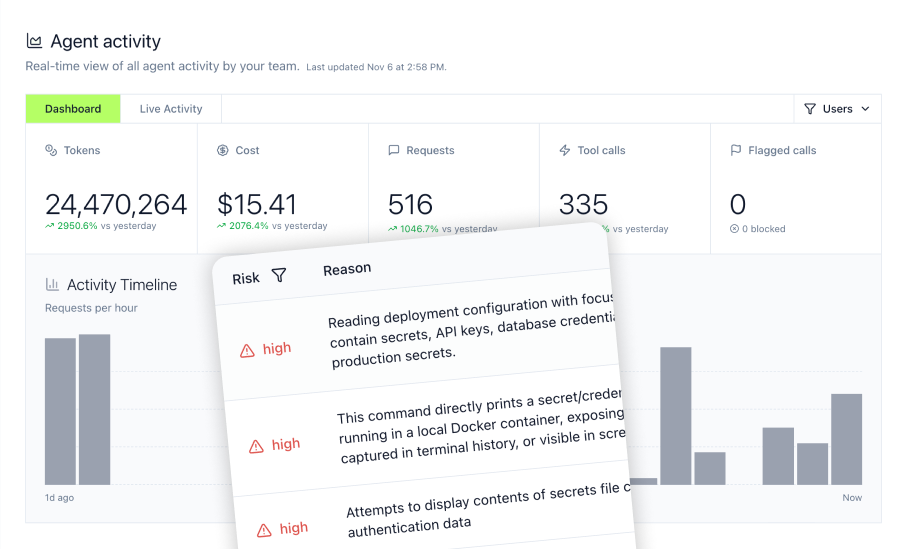
Mintive's Agent Monitor tracks every interaction between coding agents and the systems they access:
- Tool call tracking for every MCP tool invocation, bash command, and file operation
- MCP inventory showing all installed MCPs, their permissions, and usage patterns across teams
- Command history providing complete audit trails of every operation for security review
Without this monitoring, organizations cannot see what agents access or control their actions. Agent Monitor provides essential visibility and control over agent behavior.
Safeguarding Sensitive Data
Security guardrails protect against common risks:
- Dangerous command blocking in real-time before execution
- Sensitive file protection preventing access to .env files, SSH keys, credentials, and configuration files
- Risky tool call blocking such as reading environment secrets or executing potentially harmful commands
Comprehensive Audit Trails
Complete audit logging supports compliance requirements:
- Every bash command logged with timestamp, user, and context
- All file access tracked across coding agents
- Tool calls recorded for auditability, security review, and regulated-environment governance
- Real-time dashboards for monitoring and anomaly detection
Cloud Security for Enterprise AI Deployments
Enterprise AI deployments require infrastructure that meets organizational standards for availability, data residency, and operational control.
Ensuring Data Sovereignty and Resilience
Mintive provides:
- Managed SaaS-first deployment in the US and EU, with VPC and self-hosted options available on request
- Data residency options that should be reviewed directly with Mintive based on compliance requirements
- High availability with automatic failover and redundancy
- Enterprise SLAs with defined uptime commitments
These capabilities address the requirements of organizations operating across multiple jurisdictions with varying data protection regulations.
Meeting Enterprise SLAs
Service level commitments vary across platforms:
- Mintive: Uptime SLA with enterprise support options
- TrueFoundry: Standard and Enterprise SLAs with support tiers
- Lasso.Security: Support and SLA terms should be validated directly with Lasso.Security
Real-World Applications: MCP Connectors and Use Cases
MCP gateways deliver value through the connections they enable between AI assistants and enterprise systems. Mintive's hosted MCP connectors accelerate time to value across common use cases.
Data and Analytics Integration
Snowflake MCP Server enables:
- Natural language queries to data warehouses without SQL expertise
- AI-driven product analytics and user behavior analysis
- Automated financial reporting, variance analysis, and forecasting
- Executive business intelligence dashboards from governed data
Elasticsearch MCP Server supports:
- AI-powered knowledge base search across internal documentation
- Support ticket intelligence for faster diagnosis and recommendations
- Log analysis and troubleshooting through semantic search
- Product feedback aggregation with sentiment tagging
Automating Communications
Gmail MCP Server allows AI assistants to:
- Search, draft, and reply to customer emails within approved workflows
- Extract structured feedback from incoming messages
- Analyze communication flow and response patterns
- Automate customer support responses with security oversight
Enhancing Productivity with AI
Organizations often report productivity gains when deploying AI agents strategically. MCP connectors enable:
- HR teams: AI-accessible knowledge bases from company documentation and policies
- Product teams: AI-powered customer-facing documentation search
- Support teams: AI agents searching historical tickets and resolution patterns
- Finance teams: Automated reporting from data warehouse queries
- Executive teams: Real-time business intelligence without technical expertise
AI Client Compatibility
Mintive supports major AI clients:
- Claude (Desktop and Web)
- ChatGPT (via Custom GPTs and Actions)
- Microsoft Copilot
- Cursor
- Gemini
- Goose
- LibreChat
- Open WebUI
- Windsurf
- Custom MCP-compatible agents
This broad compatibility ensures organizations can standardize on Mintive regardless of which AI tools teams prefer.
Choosing Mintive for Enterprise AI Governance
Mintive delivers the deployment speed, compliance posture, and governance capabilities that enterprises need to deploy MCP at scale. The platform transforms local MCP servers into production-ready services in minutes, with SOC 2 Type II audited controls, complete audit trails, compliant with HIPAA standards, and hosted connectors for enterprise systems.
For organizations in regulated industries, Mintive can reduce security implementation work through built-in governance and audit features. For engineering teams, one-click deployment removes infrastructure complexity. For IT leaders, centralized governance provides visibility and control without disrupting developer workflows.
The managed service includes automatic failover and enterprise-managed infrastructure, while data residency requirements should be validated directly during evaluation. Mintive is managed SaaS-first in the US and EU, with VPC and self-hosted options available on request. Mintive supports two core deployment models: STDIO servers that can be deployed on the managed service, and other deployable or remote servers that organizations might already have. This flexibility enables teams to adopt Mintive incrementally, starting with high-value connectors and expanding to comprehensive governance as needs grow.
From local MCP to enterprise deployment, Mintive makes AI tools accessible to everyone in an organization while maintaining the security and governance standards enterprises require.
Ready to transform your MCP deployment? Book a demo to see Mintive in action.
Frequently Asked Questions
What is the primary difference between Mintive's MCP Gateway and its Agent Monitor?
The MCP gateway governs tool access for AI assistants across the organization, and Mint Guard screens its tool-call arguments and results. Agent Monitor covers coding agents specifically, using hooks to capture commands, file reads, and MCP calls and to block risky behavior. Both share groups, identities, and an audit trail with Mintive's LLM gateway for model calls and with Coworker Agents in Slack.
How does Mintive support compliance with regulations like SOC 2, HIPAA, and GDPR?
Mintive is SOC 2 Type II audited, with continuous compliance monitoring. The platform provides complete audit trails logging every MCP interaction, access request, and configuration change. Mintive is compliant with HIPAA standards, and customers handling protected health information can request HIPAA documentation. GDPR-oriented support should be reviewed based on audit logging, data handling, and deployment-specific requirements. These built-in governance features can streamline security review for regulated industries.
Can Mintive integrate with existing enterprise identity providers for user authentication?
Yes. Mintive integrates with enterprise identity providers through OAuth 2.0, SAML, SSO, and SCIM-driven RBAC. Supported providers include enterprise IdPs and IdP groups. A key differentiator is Mintive's OAuth brokering for stdio and hosted MCP servers, which adds enterprise authentication without requiring code changes. This capability simplifies integration with existing identity infrastructure compared to alternatives requiring more manual configuration.
What are some key business challenges that Mintive helps organizations address?
Mintive addresses several enterprise AI challenges. Shadow AI growth creates compliance risks as employees adopt tools without IT oversight; Mintive provides visibility and control that turns shadow AI into sanctioned AI. Deployment complexity slows AI adoption; Mintive's one-click deployment reduces setup time. Compliance requirements block AI initiatives; Mintive's SOC 2 Type II audited controls, compliant with HIPAA standards, and audit trails can support security review and governance requirements. Cost tracking gaps obscure AI spending; Mintive provides analytics by team, project, and tool.
Does Mintive support self-hosted deployment options for its MCP Gateway?
Mintive currently operates as a managed SaaS-first service in the US and EU, with enterprise SLAs and high availability. VPC and self-hosted deployment are available on request for organizations with specific infrastructure requirements. The managed service includes automatic failover and enterprise-managed infrastructure, while data residency requirements should be validated directly during evaluation. This approach eliminates infrastructure management overhead for most enterprise deployment needs.