Selecting the right MCP gateway and AI agent platform requires evaluating deployment speed, security posture, governance capabilities, and total cost of ownership. Mintive (formerly MintMCP), TrueFoundry, and Composio each address enterprise AI infrastructure needs through distinct approaches. Mintive's MCP Gateway specializes in transforming local MCP servers into production-ready services with one-click deployment and comprehensive governance. TrueFoundry operates as a full MLOps platform with MCP gateway capabilities alongside model training and serving. Composio focuses on pre-built integrations and API connectivity for AI agents. This comparison examines all three platforms to help engineering leaders determine which approach aligns with their organization's AI infrastructure priorities.
Key Takeaways
- Mintive deploys STDIO-based MCP servers to production in minutes through one-click deployment, while Kubernetes-based alternatives may require platform engineering setup
- Mintive offers Virtual MCP Bundles, providing per-use-case endpoints with SCIM-driven membership and curated tool access without exposing individual server complexity
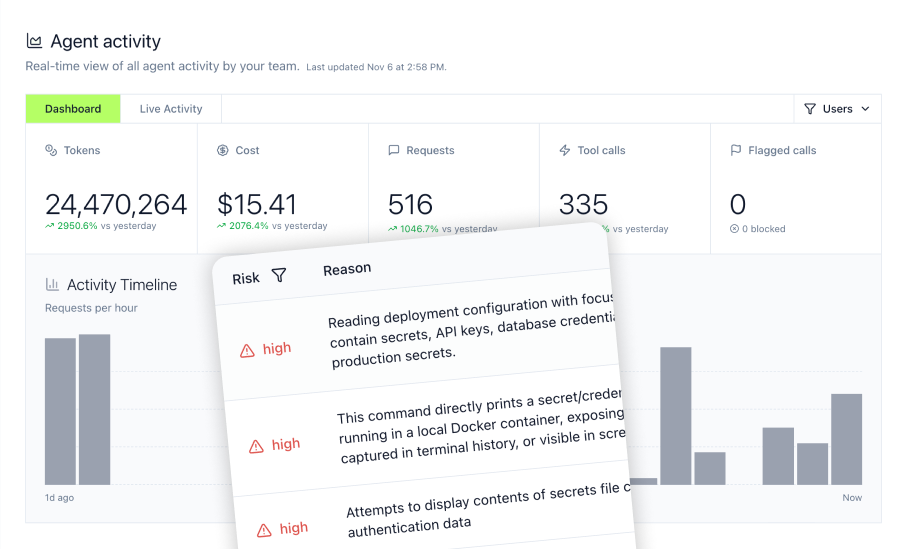
- Mintive's Agent Monitor supports coding agent governance for tools like Cursor and Claude Code by monitoring tool calls, bash commands, and file access
- Mintive is a Cursor Hooks partner for enterprise coding agent governance and visibility
Understanding AI Agent Platforms and MCP Servers
The Model Context Protocol (MCP) has emerged as the industry standard for connecting AI clients to enterprise data and tools. Supported by Anthropic, OpenAI, Google, and Microsoft, MCP enables AI assistants like Claude, ChatGPT, and Copilot to interact with databases, APIs, and internal systems through standardized server connections.
MCP gateways solve three specific problems that organizations face when deploying AI agents at scale:
- Tool Organization: Centralizing access to multiple MCP servers through unified endpoints
- Protocol Translation: Handling authentication, rate limiting, and request routing between AI clients and backend services
- Security Control: Enforcing role-based access, audit logging, and policy compliance across all AI interactions
Without proper governance, AI tools operate as black boxes with significant security risks. Organizations face zero telemetry, no request history, and uncontrolled access when deploying MCP servers without a gateway layer. Understanding MCP gateways is essential for engineering teams planning enterprise AI deployments.
The Role of MCP Servers in Enterprise AI
MCP servers act as bridges between AI assistants and enterprise systems. Each server exposes specific tools that AI agents can invoke, from querying databases to searching documents to sending emails. The challenge for enterprises lies in deploying, securing, and governing these servers at scale.
Most MCP servers are STDIO-based and difficult to deploy. They require local installations, manual credential management, and lack built-in authentication. This creates friction for IT teams and security gaps for compliance officers.
Mintive, TrueFoundry, and Composio each address these challenges differently:
- Mintive: Transforms STDIO servers into hosted, OAuth-protected services with one-click deployment
- TrueFoundry: Provides Kubernetes-native MCP gateway alongside full MLOps capabilities
- Composio: Aggregates pre-built integrations with unified authentication across SaaS applications
Data Warehouse Integration with Natural Language Queries
Finance teams, product managers, and executives need AI-powered access to data warehouses without SQL expertise. Mintive's Snowflake MCP Server enables natural language queries against enterprise data through one-click deployment with centralized governance controls.
How Organizations Deploy This Use Case
With Mintive's approach:
- STDIO-based Snowflake servers become OAuth-protected, hosted services instantly
- Administrators define which teams access specific data warehouse tools through Virtual MCP Bundles
- Finance teams query financial data using natural language without writing SQL
- Product teams analyze user behavior patterns through AI-driven queries
- Security teams maintain complete audit trails of all data access
Available tools include:
- cortex_analyst: Natural language to SQL conversion using semantic models
- cortex_search: Semantic search with filtering and column selection
- run_snowflake_query: Execute SQL queries where permitted
- query_semantic_view: Query using dimensions and metrics without writing SQL
TrueFoundry requires Kubernetes setup and infrastructure expertise to deploy similar capabilities. Composio focuses on broad tool and application integrations rather than Mintive-style MCP-specific gateway governance. Organizations prioritizing rapid data access with strong governance benefit from Mintive's specialized approach.
Enterprise Search Across Internal Knowledge Bases
Support teams and HR departments need AI assistants that can search internal documentation, policies, and historical records. Mintive's Elasticsearch MCP Server provides governed access to search infrastructure with role-based controls.
Deployment Across Teams
HR teams deploy AI-accessible knowledge bases from company documentation and policies. Support teams enable historical ticket search and resolution pattern analysis. Product teams build AI-powered documentation search for customer-facing help systems.
Mintive's one-click deployment reduces infrastructure work compared with approaches that require teams to operate their own connector runtimes. Virtual MCP Bundles ensure each team accesses only their permitted search indices without exposing the underlying complexity.
Tools include:
- search: Perform queries using Elasticsearch query DSL
- esql: Execute ES|QL queries for advanced analysis
- list_indices: Discover available indices
- get_mappings: Retrieve field mappings for specific indices
All search interactions pass through Mintive's audit logging, ensuring compliance teams maintain visibility into AI-assisted information access. According to Menlo Security's 2025 report, there has been a 68% surge in shadow generative AI usage in enterprises, making governed deployment frameworks essential.
Email Automation for Customer Communications
Customer support and sales teams benefit from AI assistants that can manage email communications securely. Mintive's Gmail MCP Server enables governed email access with complete audit trails.
Controlled AI Email Access
Organizations deploy email automation while maintaining security:
- Support teams enable AI to search historical customer communications for context
- Sales teams draft and review AI-generated emails before sending
- Compliance teams monitor all AI-assisted email activity through centralized logs
- Administrators control which teams can search, draft, or send emails
Available tools:
- search_email: Search messages using advanced query syntax
- get_email: Retrieve complete content including metadata
- draft_email: Create Markdown-formatted drafts
- draft_reply: Generate replies within existing threads
- send_draft: Dispatch prepared drafts through controlled workflows
Mintive's approach differs from Composio's pre-built SaaS integrations by providing enterprise governance and audit logging for MCP-based access. Organizations in regulated industries require this level of control over AI-assisted communications.
Coding Agent Monitoring and Security
Coding agents like Cursor and Claude Code operate with extensive system access. They read files, execute commands, and interact with production systems through MCP tools. Without monitoring, organizations cannot see what these agents access or control their actions.
Agent Monitor for Complete Visibility
Mintive's Agent Monitor addresses this gap by covering local non-MCP agent activity alongside gateway-level MCP governance. It provides:
- Tool call tracking: Monitor every MCP tool invocation from coding agents
- Command monitoring: Track bash commands executed by AI agents
- File access logging: See which files agents read or modify
- MCP inventory: Complete visibility into installed MCPs and usage patterns
- Real-time guardrails: Support policies that block dangerous commands and protect sensitive files before execution
This capability is a core Mintive focus. The Agent Monitor enables security teams to gain visibility into agent behavior while enabling developers to work productively.
Organizations deploying coding agents at scale need this level of observability. TrueFoundry's focus on MLOps means less emphasis on coding agent-specific monitoring. Composio's integration platform does not address coding agent governance as a primary use case.
Virtual MCP Bundles for Role-Based Tool Access
Enterprises managing access to dozens or hundreds of MCP servers face tool complexity and security challenges. Mintive offers Virtual MCP Bundles, an abstraction layer that changes how enterprises manage AI tool access.
How Virtual MCPs Enable Governance
Rather than exposing individual MCP servers directly to users, Virtual MCPs create unified endpoints with role-based tool configurations:
- Administrators register MCP servers with the gateway and define which tools each role can access
- Each user role receives a single endpoint with only their permitted tools pre-configured
- Users connect to their Virtual MCP without needing to know which underlying servers provide each tool
- Security teams maintain visibility and control through centralized audit logs
This approach enables enterprises to curate approved server catalogs without exposing complexity. Sales teams might access CRM tools only, while engineering teams get code repository access. The underlying MCP servers remain abstracted behind role-based endpoints.
Learn more about Virtual MCP concepts and how they enable granular tool governance.
Full MLOps with Integrated MCP Gateway
Organizations building end-to-end AI applications may need model training, fine-tuning, and serving alongside MCP deployment. TrueFoundry delivers this unified approach.
Platform Breadth and Performance
TrueFoundry's strength lies in consolidating the AI development lifecycle. Public references often frame gateway overhead as low single-digit milliseconds, but teams should validate latency against their own deployment configuration, workload, and traffic patterns. TrueFoundry also publishes throughput references, including 350+ requests per second on a single vCPU.
TrueFoundry was named a Representative Vendor in Gartner's 2025 Market Guide for AI Gateways, providing third-party validation for enterprises requiring analyst endorsement.
Deployment Options
TrueFoundry offers deployment flexibility for organizations with specific infrastructure requirements:
- VPC deployment within customer environments
- On-premises installation for air-gapped networks
- Multi-cloud support across AWS, Azure, and GCP
- Kubernetes-native architecture leveraging existing infrastructure investments
This flexibility serves teams with dedicated platform engineering resources and existing Kubernetes expertise.
Integration Platform Approach
Composio takes a different path, focusing on breadth of integrations rather than MCP-specific governance. The platform aggregates pre-built toolkits and tools across SaaS applications.
Composio's primary value is reducing integration development time. Pre-built connectors for Slack, GitHub, Salesforce, Jira, Gmail, and hundreds more enable rapid agent development without custom code.
Organizations scaling beyond prototypes into regulated production environments should evaluate whether integration breadth or governance depth better matches their requirements.
Mintive for Enterprise MCP Deployment
Mintive delivers a fast path from local MCP servers to production-ready enterprise services. One-click deployment transforms STDIO-based servers into OAuth-protected, hosted services in minutes rather than requiring teams to build connector infrastructure from scratch. This speed advantage compounds across organizations, enabling engineering teams to experiment with new MCP servers without waiting for infrastructure approvals and allowing business analysts to access AI-powered tools without depending on DevOps resources.
Virtual MCP Bundles provide governance capabilities that enable enterprises to manage AI tool access at scale. Rather than exposing individual MCP servers with their inherent complexity, Virtual MCPs create unified role-based endpoints where administrators define exactly which tools each role can access. Sales teams connect to CRM tools only, while engineering teams access code repositories and development systems. Security teams maintain complete visibility through centralized audit logs that track every interaction, access request, and configuration change.
The Agent Monitor addresses the specific challenge of coding agent visibility. As developers adopt tools like Cursor and Claude Code with extensive system access, organizations need to monitor file access, command execution, and tool invocations. Mintive's two-layer governance model combines MCP gateway controls with Agent Monitor visibility for local non-MCP agent activity, giving security teams visibility while enabling developers to work productively. This monitoring capability becomes essential as AI assistants gain broader access to production systems.
For enterprises in regulated industries, Mintive is SOC 2 Type II audited, compliant with HIPAA standards, penetration tested, and built with complete audit trails that support regulated-industry review workflows. Your security team can review Mintive's full security posture in the Trust Center. OAuth and SAML integration wraps enterprise authentication around MCP endpoints, while granular tool access controls configure permissions by role.
Mintive governs tool calls through the MCP gateway, where Mint Guard screens them, and model calls through the LLM gateway. Teams deploy AI tools with pre-configured policies rather than building governance frameworks from scratch. Self-service access enables developers to request and receive AI tool permissions, while centralized credential management eliminates scattered API keys and tokens. Mintive also supports SSO and SCIM-driven RBAC, tool-level allowlisting, rule-based policy, OAuth brokering for stdio and hosted MCP servers, Agent Bundles with M2M auth and “act as agent” flows, and hosted MCP connectors run by Mintive. This approach transforms shadow AI adoption into sanctioned, governed usage without workflow disruption.
Book a demo to see how Mintive transforms your MCP deployment from local development to enterprise production in minutes.
Frequently Asked Questions
What is the main difference between Mintive and TrueFoundry or Composio?
Mintive is a platform for running enterprise AI agents, with the MCP gateway governing tool calls and the LLM gateway governing model calls. TrueFoundry provides a full MLOps platform with model training and serving alongside its MCP gateway, while Composio aggregates pre-built integrations for SaaS applications.
Can Mintive integrate with enterprise data sources like Snowflake or Elasticsearch?
Yes. Mintive provides pre-built connectors for Snowflake, Elasticsearch, Gmail, and other enterprise systems. These connectors include natural language query capabilities, semantic search, and email automation. All integrations pass through Mintive's governance layer with full audit logging and role-based access control.
What AI clients and LLMs does Mintive support?
Mintive's MCP gateway works with Claude, Cursor, ChatGPT, Gemini, Copilot, and custom MCP-compatible agents. Its LLM gateway connects OpenAI, Anthropic, and Fireworks and routes model calls from Claude Code, Codex, Claude Desktop, and Coworker Agents, while Agent Monitor uses hooks to track coding-agent activity.
How does Mintive help monitor usage and manage costs of AI agents?
Mintive's LLM gateway shows usage and cost per model call and applies per-group budgets and allowed-model lists. New calls stop when a group reaches its budget, and Agent Monitor shows spend by user, model, and tool so teams can investigate usage and allocate costs.
Is Mintive available for self-hosted deployments?
Mintive is managed SaaS-first, with US and EU deployment options. VPC and self-hosted deployments are available on request and should be validated directly with Mintive during procurement.