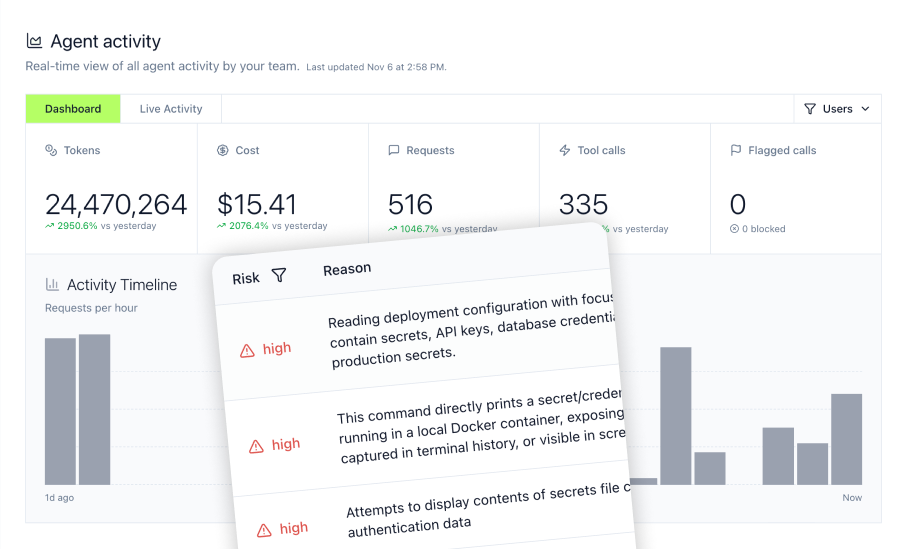
For cybersecurity companies deploying AI agents, MCP gateways have become essential infrastructure. The Model Context Protocol connects AI assistants to internal tools and data, but without proper security controls, each connection multiplies the attack surface. A well-architected MCP gateway provides the authentication, monitoring, and governance layer that transforms experimental AI deployments into production-ready systems.
The stakes are significant. With 48% of production AI agents running without active monitoring and security, security teams face an urgent infrastructure gap: how do you govern autonomous systems accessing sensitive threat intelligence, customer data, and security operations? Meanwhile, organizations increasingly rely on generative AI for critical operations, and security teams face the challenge of enabling innovation without creating new vulnerabilities.
Key Takeaways
- Performance varies dramatically, from low-overhead gateway benchmarks for real-time security operations to higher-latency approaches for deep threat scanning
- Open-source options provide code transparency for security audits, while managed platforms offer faster deployment and review paths
- Threat detection capabilities now differentiate platforms beyond basic authentication and logging
- Gateway controls address systemic MCP risks including command injection, unrestricted network access, and file leakage
- Compliance requirements such as SOC 2 Type II audits, HIPAA documentation, and BAAs can reduce procurement friction for regulated industry sales
- Identity architecture has emerged as a primary differentiator, with directory-native integration and per-agent identity now expected by enterprise buyers
- Shadow AI detection is increasingly critical as organizations need visibility into agent usage outside governed gateway paths
1. Mintive Gateway
Mintive Gateway (formerly MintMCP) has SOC 2 Type II attestation, complies with HIPAA standards, is penetration tested, and is built with auditability across agent actions. For cybersecurity companies selling to healthcare, finance, or government clients, this security posture can materially shorten vendor security assessments and reduce repetitive security questionnaires.
What Makes Mintive Different:
Mintive transforms local STDIO-based MCP servers into production services with one-click deployment, adding OAuth brokering for stdio and hosted MCP servers without manual configuration. The platform provides Virtual MCP Bundles, meaning per-use-case endpoints with SCIM-driven membership, tool curation, and access policy, so teams and agents access only the tools they need.
The key abstraction is the Virtual MCP (VMCP), which bundles connectors and a curated tool surface behind one governed endpoint for a particular team, role, use case, or agent. Hosted MCP connectors for Snowflake, Elasticsearch, and Gmail run through Mintive with built-in authentication flows.
Security + Operations:
- Complete audit trails for security reviews, incident investigations, and privacy governance
- Centralized observability with external DLP integrations through Gateway Middleware
- Enterprise SSO, SCIM-driven RBAC, and OAuth brokering for stdio and hosted MCP servers
- Tool-level allowlisting through Virtual MCPs and Rules, with managed threat detection through Mint Guard
- Agent Gateway with Agent Bundles providing M2M auth, per-agent identity, and "act as agent" flow
- Governed MCP access across Claude, Cursor, ChatGPT, Gemini, and Copilot, with Agent Monitor visibility into supported agent activity, including shadow AI detection through Cursor and Claude Code hooks
Guardrails Architecture:
Mintive's runtime controls operate through three complementary layers:
- Mint Guard: Managed detection policies for prompt injection, secrets, PII, and harmful content
- Rules: Declarative matching and enforcement on tools, arguments, or content
- Gateway Middleware: Customer-authored JavaScript logic running in a JS sandbox for DLP integrations, external classifiers, and custom policy enforcement
For most security workflows, predictable governance and auditability matter more than shaving microseconds. Mintive prioritizes policy enforcement, identity, and traceability at production scale.
Best For: Cybersecurity companies requiring audited governance, identity controls, and regulated-industry security review readiness
2. NeuralTrust TrustGate
NeuralTrust TrustGate focuses on runtime security for AI agents and MCP-connected environments, built by a security company with ISO 27001 certification and recognition in the Gartner 2025 Market Guide for AI Gateways and Guardian Agents.
Primary Focus:
The platform implements a built-in Security Engine that provides runtime content inspection and reasons across whole sessions, addressing threats that access-control-only gateways miss. TrustGate catalogs MCP tools, while NeuralTrust's TrustLens provides AI-agent discovery and continuous posture management.
Security Capabilities:
- Runtime content inspection built into the gateway itself
- Session-aware security reasoning across multi-turn interactions
- 200+ third-party MCP servers connectable in one click
- OWASP Top 10 for LLM Applications threat mapping
- SaaS, hybrid, and fully self-hosted or air-gapped deployment options
Tradeoffs to consider
Security-first runtime defense is useful for detecting agentic threats, but teams should also evaluate whether their gateway layer supports SCIM-driven RBAC, per-use-case tool bundles, audit logs, credential management, and agent identity governance. Mintive addresses those needs through Virtual MCP Bundles, Agent Bundles, OAuth brokering, and centralized observability through Agent Monitor.
Best For: Security teams prioritizing runtime content inspection and session-aware threat detection
3. Lasso Security
Lasso Security provides an open-source gateway built for MCP threat prevention. The platform gives security teams code visibility for infrastructure review, which can be important for organizations requiring gateway-level inspection before deployment. Recognized as a Gartner Cool Vendor for AI Security in 2024.
Architecture and Capabilities:
Lasso's plugin-based architecture enables modular security capabilities including prompt injection detection, command injection prevention, and PII masking with Presidio integration. The platform analyzes MCP server reputation based on behavior patterns and code analysis, addressing supply chain concerns.
Security Capabilities:
- Real-time threat detection with plugin architecture
- PII masking and redaction via Presidio integration
- MCP server reputation scoring
- Supply chain security analysis
- Prompt and command injection detection
- Shadow AI discovery with autonomous LLM interaction monitoring
Performance Consideration: Deep security scanning can add latency, which may be acceptable for high-assurance workflows but should be tested against real-time security operations requirements.
Tradeoffs to consider
An open-source, threat-prevention-first gateway can provide transparency and extensibility, but customers may need to operate deployment, connector runtime, scaling, identity integration, and policy administration themselves. Mintive addresses this with managed SaaS-first deployment, hosted MCP connectors, SSO and SCIM-driven RBAC, and centralized audit logs.
Best For: Security teams requiring code transparency, customizable threat detection, and Presidio-based PII masking
4. Runlayer
Runlayer provides a security-first governance gateway with SOC 2 Type II audited controls and HIPAA compliance support, offering managed-cloud and self-hosted deployment options, including single-tenant AWS environments.
Security Architecture:
Runlayer implements two security layers: ToolGuard scans tool definitions at registration, while AgentGuard analyzes whole sessions for behavioral anomalies. The platform supports Agent Accounts with machine-to-machine authentication, scoped policies, and audit attribution, alongside SCIM-based directory integration.
Security Capabilities:
- ToolGuard and AgentGuard for comprehensive threat detection
- Shadow AI detection via MDM integration with Jamf, Intune, and Kandji
- ML threat detection mapped to MITRE ATLAS framework
- Block-by-default stance on unrecognized patterns
- Multiple deployment options including single-tenant AWS environments
Tradeoffs to consider
Runlayer's security-first design with MDM-based shadow AI detection is compelling for security-led evaluations. Teams should compare Runlayer's Agent Accounts and identity-aware policies with Mintive's Agent Bundles and SCIM-driven Virtual MCP access controls. Mintive provides directory-native integration through SCIM, per-agent identity through Agent Gateway, and hosted MCP connectors that reduce operational overhead.
Best For: Security-led evaluations requiring MITRE ATLAS-mapped findings and MDM-based shadow AI detection
5. Bifrost by Maxim AI
Bifrost is an OSS-first, self-hosted-first gateway option for developer, platform engineering, and AI or ML teams. Published 5,000 RPS stress tests report 11µs internal gateway overhead on t3.xlarge and 59µs on t3.medium, excluding downstream request latency.
Performance Architecture:
The stateless security architecture keeps tool execution control client-side, preventing unauthorized API calls through explicit execution models. Bifrost's built-in tool registry eliminates external infrastructure requirements while the Apache 2.0 license ensures open-source flexibility.
Technical Capabilities:
- Published 5,000 RPS benchmarks report 11µs internal overhead on t3.xlarge and 59µs on t3.medium
- Self-hosted Go binary or Docker deployment model
- Native Prometheus metrics and OpenTelemetry support
- Tool registry for gateway-managed tool definitions
- Code Mode reduces token costs by up to 92% and latency by 40-50% at scale
- Unified LLM and MCP gateway in single binary
Tradeoffs to consider
A low-overhead, self-hosted gateway can be attractive for latency-sensitive teams, but cybersecurity companies should evaluate the operational work required to run the gateway, manage connector runtimes, and enforce enterprise identity policies. Enterprise tier adds OIDC, SCIM, and RBAC. Mintive addresses this with managed SaaS-first deployment, hosted MCP connectors, Virtual MCP Bundles, Agent Bundles, and audit-ready governance.
Best For: Real-time security operations requiring minimal gateway overhead and open-source transparency
6. Peta (Agent Vault)
Peta addresses a primary security concern in MCP deployments: credential exposure. Agents receive scoped, short-lived tokens instead of raw API keys, reducing credential theft risk if an agent is compromised.
Credential Security Architecture:
The three-component architecture separates secrets management from policy configuration and human oversight:
- Peta Core: Server-side encrypted vault where agents never see raw API keys
- Peta Console: Policy configuration and credential scoping
- Peta Desk: Human-in-the-loop approval workflows through a desktop application
Security Capabilities:
- Server-side encrypted vault for API credentials
- Short-lived token issuance per operation
- Fine-grained per-agent, per-tool permissions
- Dynamic provisioning with health checks
- Real-time approval notifications for high-risk actions
Tradeoffs to consider
Peta combines credential security with MCP gateway governance, managed server runtime, access policies, and audit logs. Cybersecurity companies should compare its deployment and directory integration options with Mintive's SCIM-driven Virtual MCP Bundles and first-class Agent Gateway identities.
Best For: Organizations prioritizing credential security with human approval gates for high-risk actions
7. TrueFoundry Gateway
TrueFoundry consolidates model serving, MCP orchestration, and monitoring into a single control plane, reducing fragmentation across AI infrastructure. The platform supports 250+ models and providers through unified gateway routing.
Infrastructure Consolidation:
MCP Server Groups enable logical team isolation while the interactive playground generates production-ready code snippets across multiple languages. OAuth 2.0 Identity Injection supports On-Behalf-Of (OBO) authentication, maintaining user context through agent interactions.
Infrastructure Capabilities:
- Kubernetes-native platform solving N×M integration problem through Virtual MCP Server abstraction
- 350+ requests per second on one vCPU in published LLM Gateway benchmarks, not MCP tool-call benchmarks
- Azure AD integration and comprehensive rate limiting
- Hybrid on-premise, cloud, and air-gapped deployment
- RBAC, ABAC, Cedar/OPA policy support with guardrails framework
- Consolidated billing and usage tracking
Tradeoffs to consider
A unified AI control plane can fit ML platform teams, but cybersecurity companies should evaluate whether the gateway provides data-permissions-first MCP governance for IT, Security, and AI Operations. Mintive emphasizes SSO, SCIM-driven RBAC, Virtual MCP Bundles, Agent Bundles with M2M authentication, hosted MCP connectors, and one audit stream across internal employee and internal-agent access.
Best For: Organizations wanting unified AI infrastructure management with air-gapped deployment capability
8. Portkey
Portkey delivers unified management across LLM and MCP infrastructure with detailed observability. For cybersecurity companies managing complex multi-model environments, SCIM-based organization management automates identity provisioning.
Governance Capabilities:
The platform integrates identity forwarding and centralized logging across LLM and MCP traffic, enabling consistent policy enforcement. Both SaaS and self-hosted deployment options provide flexibility for different security requirements.
Key Features:
- Multi-provider LLM routing with failover support
- SCIM-based organization management and workspace provisioning
- Identity forwarding across LLM and MCP traffic
- Centralized logging and observability
- Budget constraints and rate limits
Tradeoffs to consider
Unified observability and SCIM provisioning are important, but teams should evaluate whether the platform provides MCP-specific primitives such as Virtual MCP Bundles, Agent Bundles, stdio and hosted-server OAuth brokering, tool-update policy, and Admin MCP. Mintive provides these primitives as part of its data-permissions-first gateway model.
Best For: Organizations requiring unified LLM and MCP observability with SCIM-based provisioning
Deploy Enterprise AI with Mintive
The Model Context Protocol has fundamentally changed how enterprises connect AI assistants to their data and tools. Mintive Gateway provides a managed path from pilot to production, offering one-click deployment, identity controls, and auditability without requiring teams to build the gateway layer from scratch.
With SOC 2 Type II audited controls, compliance with HIPAA standards, hosted connectors for enterprise data sources, Virtual MCP Bundles, and rule-based tool access, Mintive removes technical barriers that keep organizations stuck in AI pilot mode. Mintive's Agent Gateway builds on the MCP Gateway foundation by extending governed data and tool access to first-class agent identities, scoped permissions, and monitoring through Agent Monitor. Whether securing access to Snowflake data warehouses, Elasticsearch knowledge bases, or custom enterprise tools, Mintive provides the infrastructure that makes AI deployment practical, governed, and secure.
For a deeper understanding of MCP gateway architecture, see the guide to understanding MCP gateways. Ready to transform AI infrastructure? Visit mintmcp.com to schedule a demo.
Frequently Asked Questions
What is an MCP Gateway and why is it essential for cybersecurity companies?
An MCP Gateway sits between AI agents and the tools they access, providing authentication, monitoring, and governance controls. Without a gateway, MCP connections operate as black boxes: limited audit trails, limited access controls, and limited visibility into what agents access. For cybersecurity companies, this creates risk exposure and makes regulated security reviews harder. Agent Monitor can further extend visibility by monitoring coding agent behavior.
How do MCP Gateways help with compliance regulations like SOC 2 and GDPR?
MCP Gateways provide audit trails and access controls that support compliance programs by improving traceability, least-privilege enforcement, and review readiness. Complete logs capture tool calls and data access for SOC 2 audits. Role-based permissions help enforce minimum necessary access. Exportable audit logs, role-based access control, and well-defined data handling processes support GDPR-aligned governance requirements. However, gateway features alone don't guarantee compliance. SOC 2 Type II audited platforms provide an independent auditor's report over security controls.
What is the difference between an MCP Gateway and an LLM Proxy in terms of security?
An MCP Gateway controls traffic between AI agents and tools, handling authentication, authorization, and monitoring for tool access. An LLM Proxy sits between AI clients and model providers, monitoring prompts, responses, and tool calls before they execute. Many organizations deploy both: gateways for tool governance and proxies for broader agent behavior monitoring.
Can MCP Gateways integrate with existing enterprise tools and data sources securely?
Yes, enterprise MCP gateways support pre-built connectors for common data sources like Snowflake, Elasticsearch, and CRM systems. Secure integration requires proper authentication configuration, typically OAuth 2.0 or SAML, plus access controls limiting which agents can reach which data. The best platforms add encryption in transit, audit logging, and rate limiting to prevent abuse.
What security signals should a top MCP Gateway provide for cybersecurity needs?
SOC 2 Type II audited controls provide strong validation, based on an independent auditor's assessment of controls over time. For regulated environments, teams should also evaluate penetration testing, encryption in transit and at rest, enterprise SSO, audit trails, role-based access control, HIPAA documentation, BAA availability, and data residency options where required.
How does shadow AI detection work in MCP Gateways?
Shadow AI detection identifies AI agent usage that occurs outside governed gateway paths. Some platforms detect this through MDM integration with tools like Jamf, Intune, or Kandji, reaching off-network laptops. Mintive's Agent Monitor provides visibility into supported agent activity including prompts, commands, file access, and MCP tool calls through Cursor and Claude Code hooks, even when that activity doesn't route through the MCP Gateway.