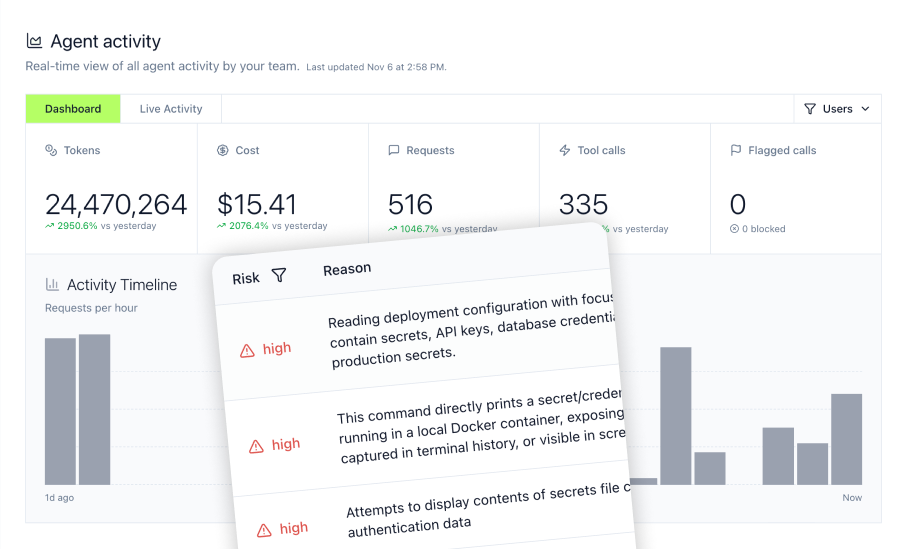
Enterprise adoption data reveals explosive growth, proven ROI, and the critical infrastructure gaps that determine AI agent success or failure
Custom AI agents are transforming enterprise operations at unprecedented speed. The global AI agents market reached $7.92 billion in 2025 and is accelerating toward $236 billion by 2034. Yet the path from pilot to production remains challenging—only 10% of organizations have successfully scaled AI agents. The difference between success and stagnation comes down to infrastructure: secure connections to enterprise data, governed tool access, and real-time monitoring. Mintive (formerly MintMCP) runs enterprise agents in production, including Coworker Agents, autonomous Slack teammates whose memory lives in a GitHub repository the team can edit. Each agent's tool calls run through the MCP gateway and its model calls through the LLM gateway, so one audit trail covers both and per-group budgets cap model spend. This analysis examines the market forces, adoption patterns, ROI metrics, and infrastructure requirements shaping custom AI agent deployment in 2025.
Key takeaways
- Market explosion validates AI agents – The AI agents market grows at 45.82% CAGR, reaching $236 billion by 2034
- Enterprise adoption is universal – 96% of enterprises plan to expand AI agent use in the next 12 months
- Security remains the top barrier – 53% cite data privacy as their primary adoption challenge
- Rapid ROI demonstrated – A commissioned Forrester study reported 210% ROI over three years with payback periods under 6 months
The rise of custom AI agents: Key industry statistics and trends
1. The global AI agents market reached $7.92 billion in 2025 and is projected to reach $236.03 billion by 2034
Market research confirms the AI agents market is experiencing unprecedented growth, expanding nearly 30-fold over nine years. This trajectory reflects mainstream enterprise adoption as organizations recognize measurable returns from AI agent investments. The market encompasses deployment platforms, integration services, and governance infrastructure required to operationalize AI agents across industries.
2. The AI agents market demonstrates a 45.82% compound annual growth rate through 2034
Industry analysts project sustained 45.82% CAGR that positions AI agents as the fastest-growing enterprise technology category. This growth rate substantially exceeds traditional software markets, reflecting urgent demand for scalable AI solutions. Organizations delaying adoption risk falling behind competitors who gain compounding advantages through earlier implementation and optimization.
3. 96% of enterprises plan to expand AI agent use in the next 12 months
Enterprise survey data reveals near-universal expansion plans, with half targeting significant organization-wide deployment. This momentum demonstrates AI agents have moved from experimental pilots to strategic priorities. The shift from "if" to "how" creates urgent demand for enterprise infrastructure that can deploy AI agents securely at scale.
4. 57% of enterprise IT leaders have implemented AI agents in the past two years
Implementation data shows rapid deployment acceleration, with 21% implementing in just the last year. This compressed timeline reflects improved tooling and proven use cases reducing perceived risk. Organizations without active implementations face growing pressure as competitors operationalize AI-driven efficiencies.
5. 79% of companies report AI agents are already being adopted
Adoption research confirms AI agents have achieved mainstream enterprise penetration across industries. This widespread adoption reduces concerns about early-adopter risk while increasing competitive pressure on organizations lagging behind. The data validates that AI agents have transitioned from emerging technology to operational necessity.
Unlocking efficiency: Performance metrics for custom AI agents
6. A commissioned forrester total economic impact study reported 210% ROI over three years with payback periods under 6 months
Financial analysis demonstrates rapid value realization from properly implemented AI agents. The compressed payback period reflects immediate productivity gains and cost reductions. Modern deployment platforms accelerate time-to-value by eliminating infrastructure complexity that traditionally extended implementation timelines.
7. 66% of companies adopting AI agents report measurable productivity increases
Productivity research demonstrates tangible efficiency gains across organizations deploying AI agents. The improvements stem from automated routine tasks, faster information retrieval, and AI-assisted decision making. These gains compound as AI agents learn from successful interactions and expand into additional use cases.
8. Recent market analysis indicates AI agents deliver 25% to 40% efficiency increases for routine operations
Industry research suggests substantial efficiency gains when AI agents handle time-sensitive and repetitive tasks. This improvement range reflects both autonomous task completion and AI-assisted human decision making. Organizations leveraging platforms like Mintive to connect AI agents with enterprise data see the highest efficiency gains through complete workflow automation.
9. 57% report cost savings and 55% report faster decision-making from AI agents
Business impact research quantifies tangible benefits across organizations deploying AI agents. The combined cost and speed improvements reflect AI agents' ability to automate analysis, retrieve information instantly, and execute decisions without human bottlenecks. These gains multiply when AI agents connect directly to enterprise data through Snowflake or Elasticsearch integrations.
10. Human-AI collaboration led to 60% productivity increases in marketing experiments
Collaboration research demonstrates substantial gains when AI agents augment human workers rather than replace them. This productivity model positions AI agents as force multipliers enabling teams to accomplish more with existing resources. The improvement validates investment in AI infrastructure that enables seamless human-agent workflows.
11. Verizon achieved a 40% sales increase after deploying an ai-powered sales assistant to support 28,000 representatives
Enterprise case study data quantifies revenue impact from AI assistant deployment at scale. This result demonstrates AI-powered tools deliver measurable business outcomes beyond cost reduction. The success required enterprise infrastructure capable of supporting thousands of simultaneous interactions with governed data access.
Bridging the gap: Deploying secure and compliant AI agents at scale
12. 53% of organizations cite data privacy as their top barrier to AI agent adoption
Barrier analysis reveals security concerns blocking enterprise AI agent deployment. This challenge intensifies as AI agents require access to sensitive customer data, financial records, and proprietary information. Solutions providing SOC2 Type II audits and complete audit trails—like Mintive's security framework—address these concerns directly.
13. 62% of practitioners and 53% of leadership identify security as a top challenge in AI agent deployment
Security research from Tray.ai confirms practitioners recognize risks from AI agents operating with broad system access. Without proper governance, AI agents become security vulnerabilities rather than productivity tools. Enterprise-grade infrastructure must provide real-time monitoring, tool access controls, and complete visibility into agent operations.
14. 40% of organizations cite integration with legacy systems as a major barrier
Integration challenges prevent organizations from connecting AI agents to existing data sources and workflows. MCP gateways solve this problem by providing standardized connections between AI clients and enterprise systems. Mintive's connector ecosystem enables AI agents to access databases, APIs, and applications without custom integration development.
15. Less than 10% of organizations have successfully scaled AI agents
Scaling research reveals a substantial gap between AI agent pilots and production deployments. The low success rate stems from infrastructure limitations, security concerns, and governance gaps that prevent expansion beyond initial use cases. This statistic underscores the critical need for enterprise-grade deployment platforms that handle security, monitoring, and scaling automatically.
16. 76% of consumers report concerns about privacy and data security when interacting with ai-powered customer experiences
Customer perception data shows widespread concern about AI-driven data exposure. This sentiment affects customer willingness to engage with AI-powered services. Organizations deploying AI agents through governed infrastructure with complete audit trails can demonstrate compliance and build customer trust.
AI automation tools: Enhancing business intelligence with AI agents
17. 66% of organizations are building agents on enterprise AI infrastructure platforms
Platform adoption data shows enterprises prefer managed infrastructure over DIY deployments. This preference reflects the complexity of security, scaling, and monitoring requirements that exceed most internal team capabilities. MCP gateways provide the infrastructure layer that transforms experimental agents into production services.
Seamless AI implementation: Integrating custom agents with enterprise data
18. Microsoft reported over 1 million custom agents created across SharePoint and copilot studio in a single quarter, with 230,000+ organizations using copilot studio
Custom development data reveals explosive growth in enterprise-built AI agents. This acceleration reflects both improved tooling and proven use cases reducing implementation risk. The surge in custom agents creates urgent demand for governance infrastructure that can manage diverse agent deployments securely.
19. 93% of software executives are developing or planning custom AI agents
Development intentions research confirms near-universal plans for custom AI agent initiatives. This widespread commitment validates AI agents as strategic priorities rather than experimental projects. Organizations need deployment infrastructure that can evolve with expanding agent capabilities and use cases.
20. The number of AI models deployed per organization doubled year-over-year to 18 in 2025
Model proliferation data shows organizations managing increasingly complex AI landscapes. This growth creates governance challenges as each model requires monitoring, access controls, and audit capabilities. Mintive's LLM gateway records usage, cost, model and latency for every model call and enforces allowed-model lists per group, and teams can switch between OpenAI, Anthropic and Fireworks without rewiring each agent. Agent Monitor adds hook-based visibility into what coding agents do with those models.
21. The average organization uses 897 distinct applications, exceeding 1,100 for AI agent deployers
Application complexity research reveals the integration challenge facing AI agent deployments. Each application represents a potential data source or action target for AI agents. MCP gateways standardize these connections, enabling AI agents to work across diverse application portfolios through unified infrastructure.
Monitoring and control: Essential for Enterprise-Grade AI agent operations
22. Microsoft announced MCP support across major products including copilot studio and Azure AI foundry
Infrastructure development from major enterprise platforms validates MCP as the emerging standard for AI-to-data connections. This ecosystem expansion reflects enterprise demand for standardized connections between AI clients and data sources, enabling organizations to deploy AI agents with confidence in long-term platform support.
Transforming local to enterprise: The role of AI gateways for custom agents
23. By 2028, 33% of enterprise software will include agentic ai—up from less than 1% in 2024
Software evolution projection anticipates fundamental transformation of enterprise applications. This 33-fold increase over four years requires infrastructure capable of governing AI agent interactions across diverse software portfolios. Organizations building AI governance frameworks now will be positioned for this transition.
24. By 2028, 15% of daily work decisions will be made autonomously by AI agents
Autonomy projection data indicates AI agents will assume significant decision-making responsibilities. This shift requires governance infrastructure ensuring AI agents operate within defined policy guardrails. Mintive's tool governance capabilities enable organizations to grant AI agents decision authority while maintaining control.
25. 40% of companies have AI agent budgets exceeding $1 million this year
Budget allocation research reveals substantial enterprise investment in AI agent initiatives. One in four large enterprises plan to spend $5 million or more in the next 12 months. This investment level demands enterprise-grade infrastructure that delivers measurable returns and governance assurance.
26. 88% of senior executives plan to increase AI budgets due to agentic AI capabilities
Budget intention data confirms executive commitment to expanding AI agent investments. This budget growth requires infrastructure that can scale with increasing deployment scope. Organizations selecting platforms with rapid deployment capabilities maximize value from expanded budgets.
27. 83% of organizations state AI agent investment is crucial to competitive advantage
Competitive priority research shows enterprises view AI agents as strategic necessities rather than optional technologies. This sentiment drives accelerated timelines and increased budgets. Organizations that deploy AI agents through governed infrastructure gain sustainable advantages while managing risk.
Strategic implementation insights
Custom AI agent success depends on infrastructure that bridges the gap between development and production. The statistics reveal a clear pattern: organizations face security barriers (53%), integration challenges (40%), and scaling limitations (less than 10% succeed) when attempting AI agent deployments without proper infrastructure.
Here's how to maximize results:
- Prioritize governed data access – AI agents need secure connections to enterprise data. MCP gateways provide OAuth-protected, auditable access to databases, APIs, and applications.
- Implement real-time monitoring – Track every tool call, data access, and agent action. Mintive's Agent Monitor uses coding-agent hooks to capture commands, file access, and MCP tool calls.
- Start with high-value use cases – Customer support (57% adoption), sales (54%), and IT operations (53%) show the highest AI agent deployment rates.
- Build for scale from day one – Infrastructure decisions made during pilots determine production success. Choose platforms that handle security, compliance, and monitoring automatically.
Organizations achieving the highest returns follow a proven pattern: deploy through enterprise infrastructure, validate governance controls, then expand use cases systematically. Mintive's deployment model transforms this approach from months to minutes.
Frequently asked questions
What ROI can organizations expect from custom AI agent deployments?
A commissioned Forrester Total Economic Impact study reported 210% ROI over three years with payback periods under six months through productivity gains and cost reductions. The key differentiator is infrastructure that enables complete workflow automation rather than basic chatbot interactions.
What are the main barriers to enterprise AI agent adoption?
53% cite data privacy as their top barrier, followed by legacy system integration (40%) and implementation costs (39%). These challenges require enterprise-grade infrastructure providing SOC2 Type II-audited security, standardized integrations, and rapid deployment capabilities. MCP gateways address all three barriers through governed connections to enterprise systems.
How quickly is the MCP ecosystem growing?
Major enterprise platforms including Microsoft have announced MCP support across products like Copilot Studio and Azure AI Foundry, validating MCP as the emerging standard for AI-to-data connections. This ecosystem expansion reflects enterprise demand for standardized, governed AI agent infrastructure.
What percentage of organizations have successfully scaled AI agents?
Less than 10% of organizations have successfully scaled AI agents across functions, despite 79% adoption rates. This gap reflects infrastructure limitations rather than technology failures. Organizations using enterprise MCP gateways with built-in security, monitoring, and governance close this gap by removing scaling barriers.
How does Mintive address enterprise AI agent deployment challenges?
Mintive brings tool and model governance into one platform: its MCP gateway controls tool access, and its LLM gateway applies model budgets and restrictions. Coworker Agents run as autonomous Slack teammates through those same gateways, so every agent, whether a developer's assistant or an autonomous teammate, shares one set of groups, identities and audit trail.